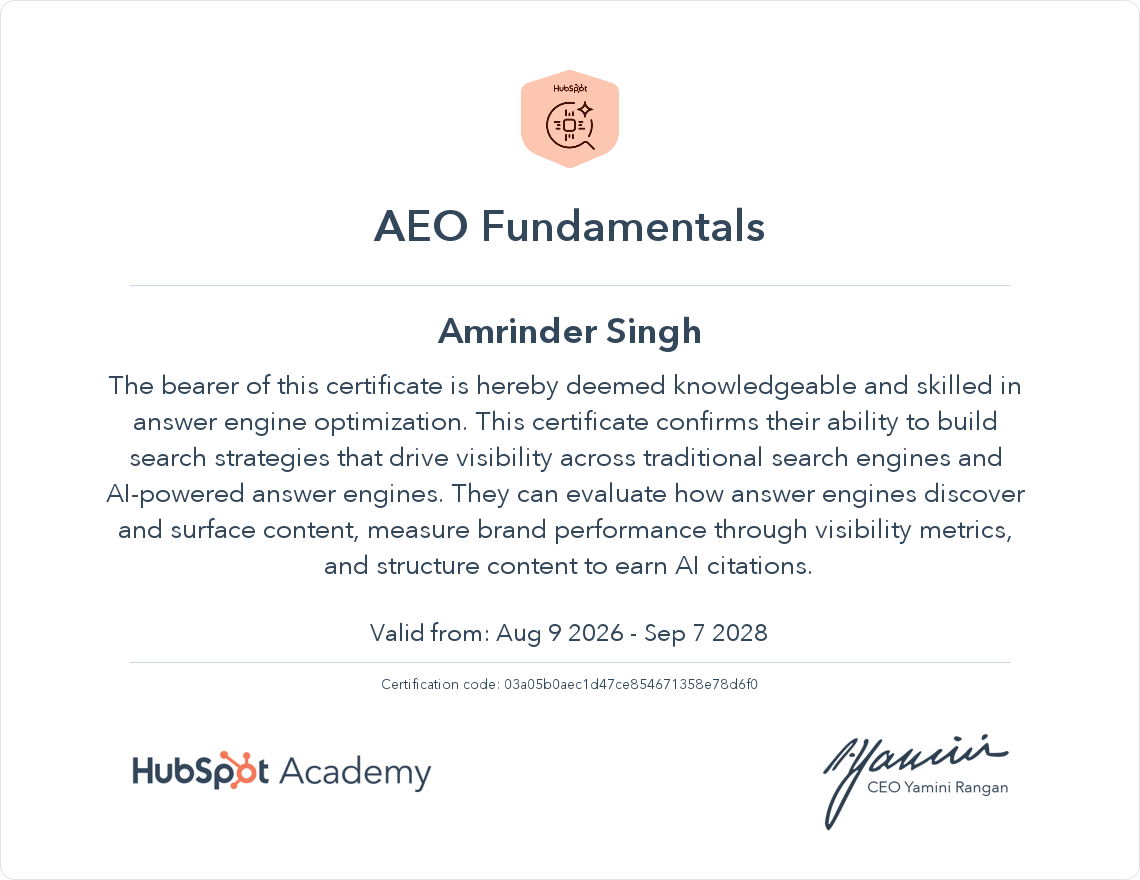
Search engine optimization isn’t dead — but it’s no longer enough on its own. AEO (Answer Engine Optimization) and GEO (Generative Engine Optimization) are the next layer of search visibility, focused on getting your content cited by AI systems like ChatGPT, Perplexity, and Google’s AI Overviews. Businesses that only optimize for traditional rankings are already losing ground to competitors who’ve adapted.
I’m Amrinder Singh, founder of DigiUstad, with 10+ years in SEO and Semrush certifications in keyword research and SEO strategy. I’ve watched this shift happen in real time — across Indian clients, international clients, and my own site.
What Is AEO and How Is It Different from SEO?
AEO — Answer Engine Optimization — is the practice of structuring your content so AI systems can extract, understand, and cite it in response to user queries. Where traditional SEO optimizes for a ranked list of blue links, AEO optimizes for the answer itself.
Think about the last time you typed a question into Google and got a direct answer box at the top before any links. That’s a simplified version of what AEO targets. Now scale that up to ChatGPT giving your brand’s explanation when someone asks “what’s the best SEO consultant in Delhi” — that’s the real prize.
The difference in practice:
| Factor | Traditional SEO | AEO / GEO |
|---|---|---|
| Goal | Rank on page 1 of Google | Get cited by AI systems as the answer |
| Format | Any indexable page | Structured, question-answer content |
| Target Platform | Google Search | Google AI Overviews, ChatGPT, Perplexity, Gemini |
| Key Signals | Backlinks, on-page keywords, technical health | E-E-A-T, FAQ schema, citation-ready content chunks |
| Content Structure | Keyword-dense paragraphs | Discrete, quotable answer blocks |
| Measurement | Rankings, organic traffic | AI citations, featured snippets, zero-click visibility |
Both matter. The mistake is treating them as separate strategies rather than complementary layers of the same visibility goal.
What Is GEO (Generative Engine Optimization) and Why Does It Matter in India?
GEO — Generative Engine Optimization — goes one step further than AEO. It’s about optimizing for the responses generated by large language models, not just Google’s featured snippets. A GEO expert in India helps businesses structure content so it gets surfaced when AI tools like ChatGPT, Perplexity, or Gemini answer questions relevant to their business.
Why does this matter specifically in India right now?
Because Indian search behavior is changing faster than most business owners have noticed. Google AI Overviews are rolling out for a wider share of queries. Urban Indian audiences — especially in B2B, professional services, ed-tech, and SaaS — are increasingly using ChatGPT and Perplexity as their first research stop, not Google.
If a potential client searches “best digital marketing consultant in Delhi” on Perplexity and your competitor comes up but you don’t — that’s lost business you never even knew you were losing.
How Did Search Actually Change — And When?
Search has been shifting gradually since Google introduced featured snippets around 2014-15. But the inflection point most businesses felt was 2023-24, when ChatGPT’s search features and Google’s Search Generative Experience (SGE — now AI Overviews) went mainstream.
Here’s the simplified timeline:
- Pre-2015: Classic SEO era — rank for keywords, drive traffic, convert. Backlinks and on-page optimization dominated.
- 2015-2020: Featured snippets & voice search — structured content started mattering more; FAQ pages became valuable.
- 2020-2022: E-A-T becomes E-E-A-T — Google started demanding Experience + Expertise + Authoritativeness + Trustworthiness, not just keyword relevance.
- 2023-2024: AI Overviews + LLM search — ChatGPT, Perplexity, and Google SGE changed who gets visibility. The answer itself became the destination, not the link to the answer.
- 2025-2026: GEO becomes a standalone discipline — businesses need dedicated strategies for LLM citation, not just Google rankings.
Most Indian businesses are still operating with a 2020 SEO mindset. That’s not a criticism — it’s an opportunity.
What Does a GEO Expert in India Actually Do?
A GEO expert in India restructures your content and digital presence so AI systems can find, understand, and cite your brand accurately and consistently.
Specifically, the work includes:
- Content restructuring for citation-readiness — breaking long paragraphs into discrete, answer-shaped chunks that LLMs can lift cleanly
- FAQ schema implementation — formatting your most important answers in structured data so Google AI Overviews and voice assistants can pull them directly
- E-E-A-T reinforcement — author bios, certification mentions, real case studies with data, all of which signal to both Google and LLMs that your content is trustworthy
- Quick Answer blocks — a 40-60 word direct answer at the top of every key page, structured exactly the way AI systems prefer to extract information
- LLM testing — literally asking ChatGPT and Perplexity questions your target customers would ask, checking whether your brand appears, and reverse-engineering why competitors do if you don’t
[CLIENT EXAMPLE]: After restructuring the content on a service page with proper FAQ schema, Quick Answer blocks, and E-E-A-T signals, one of my clients started appearing in Google AI Overview responses for their primary service keyword within 6 weeks — a keyword they’d been trying to rank for traditionally with minimal movement for months.
How Do You Optimize for AI Overviews Specifically?
Google AI Overviews pull from pages that are already ranking well, but with a strong preference for content that’s structured to answer questions directly. Here’s the practical process I follow:
- Identify the exact question format — search your target keyword, note how Google phrases the AI Overview question, and match that phrasing in your H2 headers
- Write a direct answer in the first sentence under each heading — don’t build up to the answer; give it first, then elaborate
- Use numbered lists and tables where appropriate — AI systems love structured formats they can present cleanly
- Add FAQPage schema — mark up your FAQ section with structured data so Google can parse it directly
- Strengthen E-E-A-T signals — include author credentials, publication dates, real data points, and first-hand experience language
- Keep paragraphs short — 3-4 sentences maximum; long paragraphs get skipped by both AI extractors and human readers
- Build internal links between related content — topic clusters signal to Google that you’re a genuine authority on the subject, not just one keyword-targeted page
Is Traditional SEO Still Worth Doing in 2026?
Yes — absolutely. Traditional SEO and GEO/AEO aren’t competing priorities.
The reason is simple: Google AI Overviews still primarily cite pages that rank well in traditional search. If your page isn’t indexed, well-linked, and technically sound, it won’t appear in AI Overviews either. You need the foundation of good SEO before GEO optimization can do its full job.
What’s changed is the endpoint. A well-optimized page in 2026 doesn’t just drive click-through traffic — it earns citations, featured placements, and zero-click visibility that builds brand authority even when no one clicks the link.
But it does mean your content strategy needs to serve two masters now: the traditional ranking algorithm and the AI citation system. They’re mostly aligned — quality, structured, expert content wins in both — but the AEO/GEO layer adds specific formatting requirements that traditional SEO alone wouldn’t prioritize.
FAQs
What is the difference between SEO, AEO, and GEO?
SEO (Search Engine Optimization) targets traditional Google rankings through keywords, backlinks, and technical health. AEO (Answer Engine Optimization) structures content to appear in AI-generated answer boxes and featured snippets. GEO (Generative Engine Optimization) goes further, optimizing for citations by large language models like ChatGPT, Perplexity, and Gemini.
What is a GEO expert in India?
A GEO expert in India is an SEO professional who specializes in optimizing websites and content to be cited by AI search systems — including Google AI Overviews, ChatGPT search, and Perplexity — in addition to traditional search rankings.
Do I need AEO if my website already ranks well on Google?
Yes — traditional rankings don’t automatically translate into AI Overview citations or LLM mentions. You need additional content structuring (FAQ schema, Quick Answer blocks, E-E-A-T reinforcement) to capture that visibility layer, even if your page already ranks on page one.
How long does it take to appear in Google AI Overviews?
There’s no fixed timeline, but well-structured pages with FAQ schema and strong E-E-A-T signals have appeared in AI Overviews within 4-8 weeks of optimization in practice. Pages that already rank in the top 5-10 for a query tend to see faster results.
Is GEO optimization expensive?
Not inherently — most GEO work involves restructuring existing content rather than creating net-new pages from scratch. For a Semrush-certified specialist, expect GEO optimization to be bundled with or add a modest increment to existing SEO retainer costs, not a separate budget category entirely.
Can small Indian businesses benefit from GEO and AEO?
Yes — and arguably more than large ones, because most small Indian business websites haven’t made these optimizations yet. Getting cited in an AI Overview for a local or niche query while competitors haven’t adapted is a significant early-mover advantage.
The businesses that treat GEO and AEO as "future things to think about later" are making the same mistake businesses made in 2012 when they treated mobile optimization as optional. The search landscape has already shifted. The question now is how quickly your content catches up. If you want to know whether your site is currently structured to be cited by AI systems — or what's preventing it — that's exactly the kind of audit I run at DigiUstad. Start there.