If your SEO agency cannot explain why your business doesn’t appear in ChatGPT, Perplexity, or Google AI Overviews, it’s because AI search invisibility is not an SEO problem. It’s an entity and structure problem — and most SEO agencies haven’t built the diagnostic framework to identify it. The causes are specific, verifiable, and fixable in weeks, not months.
Why “It Takes Time” Is the Wrong Answer
“It takes time” is a legitimate answer for traditional Google rankings. Building domain authority, earning backlinks, and climbing keyword positions genuinely does take months of consistent work.
But AI search doesn’t work that way.
AI systems don’t rank your pages. They select your content. When someone asks ChatGPT “best [your service] in [your city]” — ChatGPT doesn’t evaluate your domain authority or your backlink profile. It asks a completely different set of questions:
- Can I read this website without being blocked?
- Does this business exist consistently across independent platforms?
- Can I extract a direct answer from this page?
- Have other trusted sources referenced this business?
If the answer to any of these is no — you’re invisible. And the fix for each one takes days, not months.
The reason your SEO agency says “it takes time” is not because AI visibility takes time. It’s because they’re applying the traditional SEO timeline to a different discipline that has a different timeline and different diagnostic criteria.
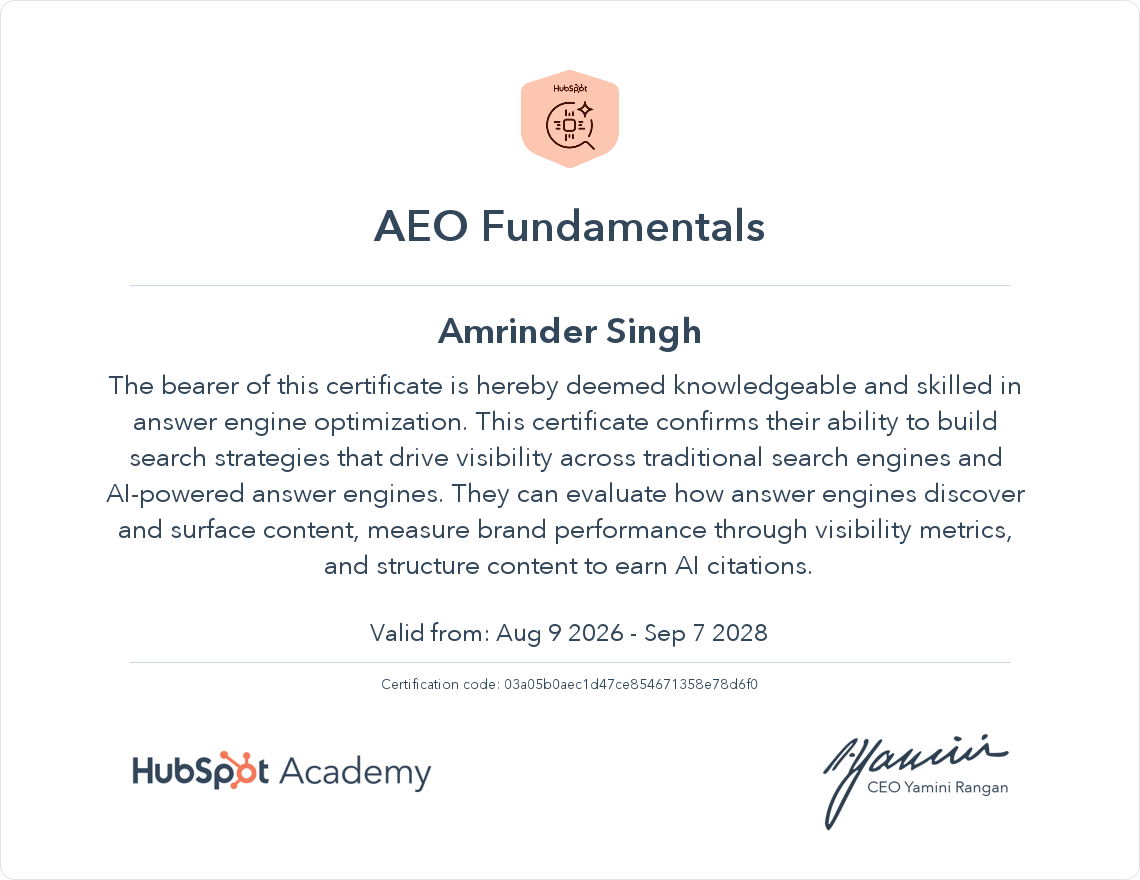
I’m Amrinder Singh, founder of Digi Ustad — Semrush AI Visibility certified, 10+ years in SEO, Wikidata entity Q140338594. I ran the full AI visibility framework on my own site before offering it to clients. The result: 3 organic clicks to 197 in 43 days, and ChatGPT now cites Digi Ustad for SEO queries in India — confirmed through utm_source=chatgpt.com in Google Analytics 4.
That’s not “it takes time.” That’s a specific set of changes producing a measurable result in a specific timeframe.
What Is Actually Causing Your AI Search Invisibility?
AI search invisibility has five diagnosable causes. Your SEO agency should be able to tell you which one applies to your site within 30 minutes of looking at the right data.
Cause 1 — AI Crawlers Are Blocked
This is the most fixable cause and the most commonly missed one.
AI crawlers — GPTBot (ChatGPT), PerplexityBot (Perplexity), Google-Extended (Google AI Overviews), ClaudeBot (Claude) — all read your robots.txt file before attempting to crawl your site. If they’re blocked, they cannot read your content. Doesn’t matter how good your content is. Doesn’t matter how many backlinks you have. Blocked means invisible.
Check yours right now: go to yourdomain.com/robots.txt. Look for these entries:
					User-agent: GPTBot
Disallow: /

User-agent: PerplexityBot
Disallow: /
If you see Disallow: / next to any of these — that’s your answer. Your SEO agency should have caught this on day one of any AI visibility audit. If they haven’t looked at your robots.txt in the context of AI crawlers — they’re not doing AI SEO, they’re doing regular SEO with a new label.
Cause 2 — Your Content Is Behind JavaScript
AI crawlers, unlike modern browsers, generally cannot render JavaScript. If your website serves content through JavaScript — common in React, Vue, or Next.js sites, and some WordPress themes — AI crawlers may be reading a blank page.
Test this yourself: open Chrome, go to Settings, search “JavaScript,” set it to “Block,” and reload your homepage. If your content disappears or is significantly reduced — AI crawlers may be seeing that blank version.
This is a technical fix that requires a developer, but it’s not a months-long project. Server-side rendering or pre-rendering typically resolves it within days.
Cause 3 — You Don’t Exist as a Verifiable Entity
This is the cause most SEO agencies have never heard of in the context of AI search.
AI systems don’t just read your website. They cross-reference your business across every platform they can find — Google Business Profile, Yelp, LinkedIn, industry directories, news mentions, review platforms, Wikidata. They’re trying to verify that you’re a real, established business before recommending you.
If your business name appears differently on your website versus your Google Business Profile versus your Yelp listing versus your LinkedIn page — AI systems can’t form a confident, unified picture of who you are. The technical term for this is weak entity signals.
The fix: consistent NAP (Name, Address, Phone) across every platform where your business appears, a Wikidata entity for your brand or founder, and a presence on at least three to four independent platforms beyond your own website.
As a 2026 study found, only 1.2% of local businesses appear in AI search citations. The 98.8% that don’t are largely missing entity verification signals — not keyword optimisation.
Cause 4 — Your Content Isn’t Structured for AI Extraction
AI systems don’t summarise entire pages. They extract specific answers. A page that buries the answer to a question in paragraph seven, after three paragraphs of company history and a generic welcome message, will not be cited — even if the answer is excellent once you find it.
The structural requirements for AI citation are specific:
- Direct answer in the first 60 words of each key page
- H2 headings phrased as the actual questions users ask
- FAQ sections with 40 to 60 word self-contained answers
- FAQPage schema marking those FAQ sections as machine-readable
None of this is a traditional SEO concern. Traditional SEO cares about keyword density, internal linking, and page authority. AI visibility cares about whether a sentence can be extracted, verified, and quoted without the surrounding context.
A well-structured page can begin getting cited by Perplexity within days of being indexed — because Perplexity performs real-time web searches. ChatGPT citations typically follow within six to twelve weeks. This is not “it takes time.” This is a predictable timeline for a specific set of changes.
Cause 5 — You Have No Third-Party Corroboration
The most underestimated factor in AI visibility: what other people say about your business matters more than what you say about yourself.
Research consistently shows that the majority of AI citations come from third-party sources — review platforms, directories, editorial mentions, Reddit threads, LinkedIn posts, industry publications. Your own website accounts for a fraction of what AI systems use to evaluate whether to recommend you.
If your digital presence exists primarily on your own website — no Yelp profile, no Clutch listing, no Medium articles, no Quora answers — AI systems have very limited independent evidence that your business is worth recommending. They default to businesses with richer third-party corroboration.
This is where the traditional SEO mindset creates a blind spot. SEO agencies focus on your website. AI visibility requires building a presence across the web that exists independently of your website.
What Should Your SEO Agency Be Able to Tell You?
If you ask your SEO agency why you’re not in AI search, they should be able to answer these five questions immediately:
- Are your AI crawlers permitted in robots.txt? This takes 60 seconds to check. If they don’t know, that’s a problem.
- Is your content rendering for AI crawlers? Disable JavaScript test, or a quick crawl with a headless browser. Diagnosable in under 10 minutes.
- What is your current Share of Model? Share of Model is the percentage of your tracked queries where you appear in AI-generated answers. If they’ve never heard this term, they’re not doing AI SEO.
- How consistent is your NAP across platforms? A BrightLocal or Whitespark citation audit takes 10 minutes to run. The results tell you immediately whether entity inconsistency is a factor.
- Where does your GA4 show AI referral traffic? Go to GA4 → Traffic Acquisition → Session source. Look for chatgpt.com, perplexity.ai, gemini.google.com. If there are zero sessions from these sources after months of “AI SEO work” — the work isn’t landing.
If your agency can’t answer all five — they’re not doing AI search optimisation. They’re doing traditional SEO and calling it AI SEO.
AI Search vs Traditional SEO — Why the Timeline Is Different
| Factor | Traditional SEO | AI Search Visibility |
|---|---|---|
| Primary Goal | Rank higher in Google Search results for target keywords. | Get cited and recommended in AI-generated answers across modern AI search platforms. |
| What Gets Evaluated | Backlinks, keyword relevance, topical authority, page quality, and on-page optimization. | Entity recognition, structured content, citations, brand authority, and third-party validation. |
| Fastest Results | Typically 3–6 months before noticeable keyword ranking improvements. | Days to weeks for Perplexity and around 6–12 weeks for ChatGPT and other AI platforms. |
| Success Metric | Keyword rankings, organic traffic, and search visibility. | Share of Model (SoM), AI citations, mentions in ChatGPT, Perplexity, Gemini, and Google AI. |
| Measurement Tools | Google Search Console, rank tracking software, and analytics platforms. | GA4 AI referral traffic, AI visibility tracking, manual prompt testing, and citation monitoring. |
| Common Challenges | Weak backlink profile, limited authority, poor technical SEO, or thin content. | Blocked AI crawlers, weak entity signals, missing structured data, and unstructured content. |

The reason “it takes time” is wrong for AI search is that the blockers are different. A blocked AI crawler is fixed in minutes. Unstructured content is fixed in days. Entity signals build over weeks. None of these follow the 6 to 12 month traditional SEO timeline.
What does take time in AI search: Share of Model growth — building from appearing in 10% of your target queries to 40% or 50% takes 3 to 6 months of consistent work. But that’s growth, not the initial fix. You can go from zero AI citations to first Perplexity citations in under four weeks with the right changes.
The One Question That Reveals Everything
Ask your SEO agency this: “Does your own website appear in ChatGPT when someone searches for your service category?”
If it doesn’t — the conversation ends there. An agency that can’t achieve AI visibility for themselves cannot achieve it for you.
I run Digi Ustad. When someone types “best GEO expert in Delhi” or “AEO consultant India” into ChatGPT — Digi Ustad appears. Confirmed through referral traffic in GA4, not through manually typed queries I curated. That’s the standard to hold your agency to.
For businesses specifically looking for proven AI visibility expertise in the Toronto and GTA market, the best AI visibility consultant in Toronto and best AI SEO expert in Toronto pages cover what verified AI citation proof actually looks like — and the questions to ask before hiring anyone.
FAQ: Why Am I Not in AI Search?
Why does my SEO agency say "it takes time" for AI search results?
Most traditional SEO agencies apply the same timeline expectations to AI search that they use for Google rankings — 6 to 12 months for meaningful results. But AI search invisibility has specific, diagnosable causes that are fixed on different timelines: a blocked AI crawler is fixed in minutes, content restructuring takes days, and entity building takes weeks. “It takes time” is often a sign the agency hasn’t diagnosed the actual cause.
What is the fastest way to check if I'm blocked from AI search?
Go to yourdomain.com/robots.txt and look for Disallow entries next to GPTBot, PerplexityBot, ClaudeBot, and Google-Extended. If any of these are blocked, that’s the immediate cause of your AI invisibility. Also disable JavaScript in your browser and reload your homepage — if content disappears, AI crawlers may be reading a blank page.
How long does it actually take to appear in ChatGPT or Perplexity?
Perplexity performs real-time web searches — well-structured new content can appear in Perplexity results within days of being indexed. ChatGPT citations typically begin within six to twelve weeks of implementing entity signals, content restructuring, and schema markup. The full Share of Model growth from first citations to consistent visibility takes three to six months.
What is Share of Model and why does it matter?
Share of Model is the percentage of your tracked target queries where your brand appears in AI-generated answers across ChatGPT, Perplexity, and Google AI Overviews. It’s the primary KPI for AI search visibility — equivalent to keyword rankings in traditional SEO. If your agency doesn’t track Share of Model monthly, they’re not measuring AI search performance.
Can a small business realistically appear in ChatGPT recommendations?
Yes. AI citation is not proportional to company size, advertising budget, or domain authority. It’s proportional to entity clarity, content structure, and third-party corroboration. A small business with consistent NAP across directories, strong local reviews, FAQPage schema, and a Wikidata entity will outperform a larger business that lacks those signals.
What should I look for in an agency that actually does AI search optimisation?
Ask five questions before hiring: Does your own website appear in ChatGPT for your service category? Do you have a Wikidata entity? Can you show me GA4 data with AI referral sessions? Can you define Share of Model and show me how you track it? What is my current AI crawler access status in robots.txt? An agency that can answer all five clearly is doing real AI search optimisation. An agency that deflects any of them isn’t.
The businesses appearing in ChatGPT, Perplexity, and Google AI Overviews for your service category right now didn't get there by waiting. They got there because someone identified the specific blocker — a crawl restriction, a structural gap, a missing entity signal — and fixed it.
If your agency can’t name the specific cause of your AI invisibility, the problem isn’t that it takes time. The problem is that the diagnosis hasn’t happened yet.