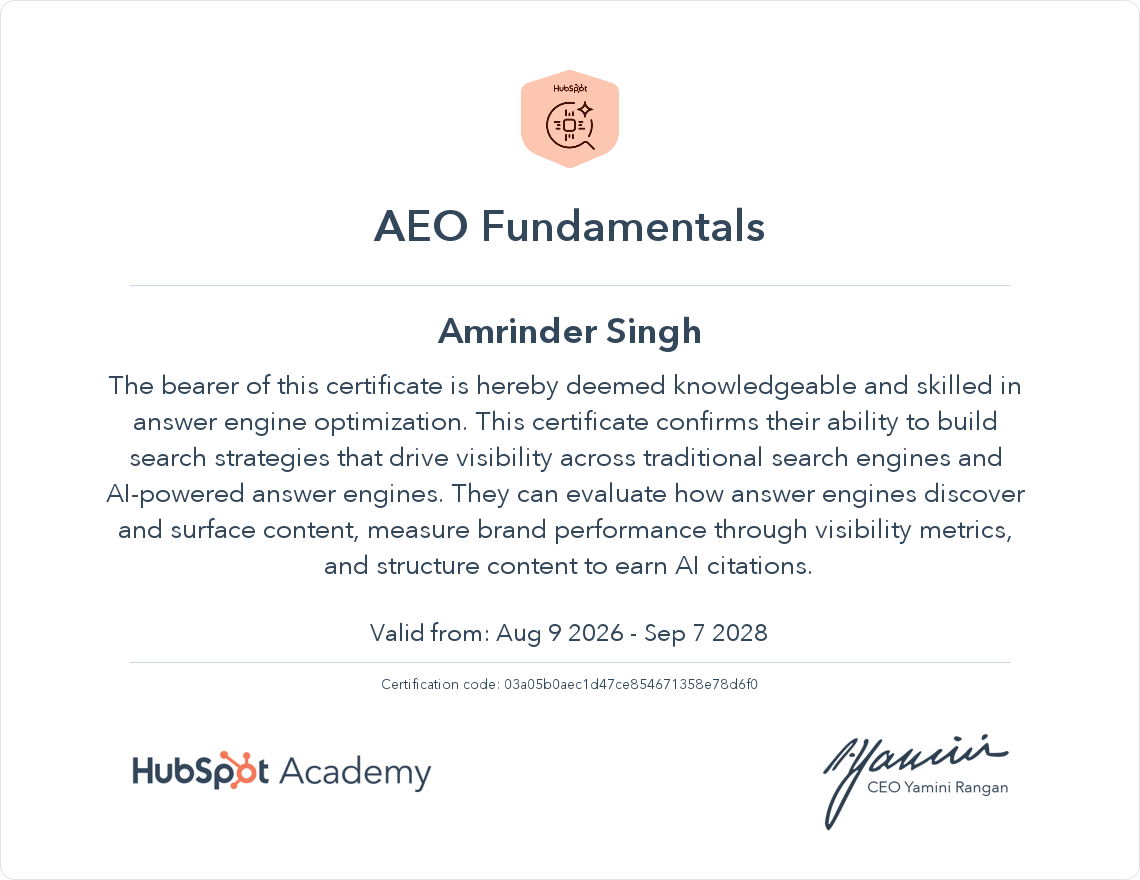
AEO — Answer Engine Optimization — is the practice of structuring content so that AI-powered systems like Google AI Overviews, ChatGPT, and Perplexity select and cite it when generating answers to user queries. Unlike traditional SEO, which optimises for keyword rankings and clicks, AEO optimises for citation — being the source AI systems quote when they answer a question. For Indian businesses, AEO is currently the most underpenetrated digital marketing opportunity available.
What Is AEO and How Do I Do It?
AEO is the practice of making your content the answer that AI engines deliver — not just a link they rank. You do it by placing direct answers in the first 60 words of every key page, using question-based headings, implementing FAQPage and HowTo schema, and building entity signals that AI systems can verify independently.
I’ve been practising traditional SEO for over 10 years. AEO is a genuinely different discipline — not a rebrand, not just “better SEO.” I know this because I’ve tested it directly on Digi Ustad’s own pages. One of my service pages ranked third on Google for its target query and was never cited in AI Overviews. I moved the direct answer from paragraph seven to the opening two sentences. Within eleven days, the page was being cited. Same ranking. Same backlinks. Different structure.
That’s AEO in practice.
What Is Answer Engine Optimization — The Simple Definition
Answer Engine Optimization is the discipline of structuring content so AI-powered answer systems can extract, trust, and cite it — regardless of whether the user then clicks through to your website.
The name explains the shift. Traditional search engines were directories — they pointed users to websites. Answer engines are responders — they generate the answer directly, sometimes citing sources, sometimes not.
Google AI Overviews now appear in over 55% of all Google searches. ChatGPT handles over 2 billion queries daily. AI-referred sessions to websites grew 527% year-over-year through mid-2025. The search journey is no longer: search → click → website. It’s increasingly: ask → AI answers → maybe click.
For an Indian business, this changes the game fundamentally. If a potential customer in Delhi asks ChatGPT “best CA for GST filing in Rohini” — the CA who appears in that AI answer gets the enquiry. The CA who ranks fourth on Google but isn’t cited gets nothing from that search.
AEO vs SEO — Which Is Better for Indian Businesses?
Neither is better — you need both. SEO builds the foundation that makes AEO possible. AEO is the layer on top that makes your content citation-ready.
Here’s the honest comparison:
| Factor | Traditional SEO | AEO |
|---|---|---|
| Goal | Keyword rankings and clicks | AI citations and brand mentions |
| Content evaluated | Entire page | Individual passages |
| Success metric | Organic traffic | Share of Model (citation rate) |
| Schema impact | Helpful for rich results | Critical for citation eligibility |
| Named author | Beneficial | Often required for YMYL topics |
| Timeline | 3–6 months for rankings | 4–8 weeks for initial citations |
| Measurement | GSC clicks and impressions | Manual testing + GA4 AI referral traffic |
The practical reality for most Indian businesses: A page can rank well and still never appear in an AI response. The reverse can also happen: a page earns citations even when it doesn’t drive a visit.
This is why I tell clients that AEO doesn’t replace their existing SEO work — it extends it. All the technical SEO fundamentals, all the content quality work, all the backlink building — it all still matters. AEO adds a specific structural layer on top.
For Indian SMBs specifically, I recommend starting with AEO on your three highest-traffic pages before building new content. The fastest wins come from restructuring pages that already rank — not from creating new content from scratch.
What Is GEO — Generative Engine Optimization — and How Is It Different from AEO?
GEO (Generative Engine Optimization) is the newer, more specific discipline focused on getting content cited by generative AI systems like ChatGPT, Perplexity, and Gemini. AEO is the broader discipline that includes featured snippets, People Also Ask boxes, voice search, and AI Overviews.
Think of them as nested disciplines. AEO is the older and broader discipline encompassing all practices that help content earn answer-box positions. GEO is a newer and more specific discipline, emerging in 2025–2026, focusing specifically on optimising content to be cited by generative AI systems.
For most Indian businesses in 2026, AEO is the higher priority — because Google still commands 93%+ market share in India, and Google AI Overviews are where the majority of answer-box traffic comes from. GEO becomes critical as ChatGPT and Perplexity usage grows — which is already happening in India’s B2B, finance, healthcare, and technology sectors.
In practical terms, the work overlaps significantly. Optimising well for AEO improves your GEO performance simultaneously, because both reward the same fundamentals: direct answers, clear entity signals, structured schema, and verified E-E-A-T.
How to Do AEO for Your Business — Step by Step
Step 1 — Audit your top 5 pages for answer placement
Open each page and read only the first 60 words. Does it directly answer the core question implied by the page’s topic? If not — move the direct answer to the opening paragraph. This single change is the highest-impact AEO improvement available and costs nothing except time.
Step 2 — Restructure headings as questions
Every H2 and H3 should be phrased as a question that real users ask. Not “Our Services” — but “What SEO services do you offer for Delhi businesses?” Not “About AEO” — but “What is AEO and how does it work?” AI systems match questions to question-based headings directly.
Step 3 — Add FAQ sections to every key page
Add 5–6 question-and-answer pairs to every important page. Each answer should be self-contained in 2–3 sentences — complete without needing surrounding context. This is what makes answers extractable.
Step 4 — Implement FAQPage schema
Add FAQPage JSON-LD schema matching your visible FAQ content exactly. In WordPress, Rank Math makes this straightforward — go to Schema → FAQPage and add each Q&A pair. Validate at search.google.com/test/rich-results. Pages with schema markup are significantly more likely to appear in AI Overview citations than equivalent unstructured content.
Step 5 — Add a named author with verifiable credentials
Every page you want cited needs a named author — not “the editorial team” or “Digi Ustad.” A named person with verifiable credentials: certifications, case studies, a Wikidata entity. AI systems cross-reference author credibility before citing content on YMYL topics.
On every Digi Ustad page, my name (Amrinder Singh) appears with my Semrush certification IDs (35ea95ffb6, 4970dff0a6, ab9dd2ec73) and links to verifiable proof. This is not vanity — it’s the E-E-A-T infrastructure that makes AI citation more probable.
Step 6 — Build entity consistency across platforms
Create and maintain consistent profiles on Wikidata, LinkedIn, Medium, Dev.to, Google Business Profile, and relevant directories — all using identical name, address, and contact details. AI systems verify brand credibility by cross-referencing multiple trusted sources.
This is what drove Digi Ustad’s ChatGPT citations — not a single article, but consistent entity signals across Wikidata (Q140338594), LinkedIn, Medium, Dev.to, unmatchedcontent.com, and Gumroad all saying the same things about Amrinder Singh and Digi Ustad.
Step 7 — Check AI crawler access
Confirm your robots.txt does not block GPTBot, Google-Extended, or PerplexityBot. Add an llms.txt file to your root directory. These two technical checks take 30 minutes and have immediate impact on AI visibility.
Step 8 — Track your Share of Model monthly
Measure your AEO results using Share of Model — the percentage of your tracked queries where your brand appears in AI answers. Test 15–20 queries monthly across Google AI Overviews, ChatGPT, and Perplexity. Log appearances in a spreadsheet. Or use the free AI Visibility Checker to calculate your score in under 5 minutes.
AEO Strategy for Small Business in India — What Actually Works
Most AEO guides are written for enterprise teams with content departments and dedicated tool budgets. Here’s what actually works for an Indian small business doing AEO without a large team or expensive software:
Focus on your 3 highest-impression GSC pages first Open Google Search Console → Performance → sort by impressions. Your top 3 impressions pages with low CTR are your fastest AEO wins. These pages are already being shown to users — they just need restructuring to get cited.
Use free tools exclusively to start
- Google Search Console — query data and impression monitoring
- Google AI Overviews — manual testing (just Google the query)
- Perplexity.ai — real-time citation testing (free)
- ChatGPT free tier — brand mention testing
- Rank Math free — FAQPage and HowTo schema
The Indian SMB AEO priority order:
- Fix answer placement on existing pages
- Add FAQ sections to service pages and homepage
- Add FAQPage schema to all FAQ sections
- Create or complete Wikidata entity
- Publish monthly on at least one high-DA platform (LinkedIn, Medium)
- Test and track monthly
This sequence costs nothing except time and produces measurable AEO results within 4–8 weeks. I’ve followed exactly this sequence for Digi Ustad’s own content — and the ChatGPT citations followed.
How to Optimize for ChatGPT Specifically
To appear in ChatGPT answers, you need both pre-training data coverage and real-time web citation. Here’s how each works for an Indian business:
Pre-training data coverage comes from your brand being mentioned consistently across trusted platforms before the model’s training cutoff. This is why publishing on LinkedIn, Medium, Dev.to, Quora, and industry directories matters — each platform mention contributes to ChatGPT’s background understanding of who you are and what you do.
Real-time web citation (available in ChatGPT 4o and newer with browsing) works on the same principles as Google AI Overviews — direct answers, clean structure, strong E-E-A-T. When ChatGPT browses the web for a query, it pulls from the same pool of indexed, structured, authoritative content that Google AI Overviews do.
The practical implication: AEO work done for Google AI Overviews directly improves ChatGPT citation probability simultaneously. You don’t need a separate ChatGPT optimisation strategy — you need strong AEO fundamentals applied consistently.
Digi Ustad’s ChatGPT citations appeared after building entity signals across Wikidata, LinkedIn, Medium, Dev.to, and unmatchedcontent.com — not from any ChatGPT-specific tactic. The citations are confirmed through utm_source=chatgpt.com referral traffic in Google Analytics.
Answer Engine Optimization Guide India — The Opportunity Right Now
India has over 900 million internet users. Google AI Overviews are live and appearing in Hindi and English searches. ChatGPT reached 10 million monthly active users in India by early 2024.
And almost no Indian small business has done any deliberate AEO work yet.
That’s the opportunity. The Delhi CA, the Mumbai D2C brand, the Bangalore SaaS startup, the Hyderabad healthcare clinic — the ones that build AEO structure into their content now will have a compounding advantage by the time their competitors catch up.
The brands investing in AEO now will earn disproportionate attention, trust, and demand as AI search continues to grow.
I’ve seen this first-hand with Digi Ustad. Six months of deliberate AEO work — entity building, schema implementation, content restructuring — resulted in ChatGPT naming me as a top GBP expert in India. That citation now generates real referral traffic, verified in Google Analytics.
The same approach is available to any Indian business willing to do the structural work.
FAQ: What Is AEO — Answer Engine Optimization
What is AEO (Answer Engine Optimization)?
AEO is the practice of structuring content so that AI-powered systems like Google AI Overviews, ChatGPT, and Perplexity select and cite it when generating answers. Unlike traditional SEO which optimises for keyword rankings, AEO optimises for citation — being the source AI systems quote when answering a user’s question. The core requirement is placing a direct answer in the first 60 words of every key page, supported by FAQPage schema and verified E-E-A-T signals.
Is AEO better than SEO for Indian businesses?
Neither replaces the other. SEO builds the foundation — rankings, authority, technical health — that makes AEO possible. AEO is the layer on top that makes content citation-ready for AI systems. For Indian businesses, the recommended approach is strong traditional SEO as the base, with AEO structure — direct answers, question headings, FAQPage schema, entity signals — applied to every key page. Both disciplines share the same content quality fundamentals.
How long does AEO take to show results in India?
Initial AI citation improvements typically appear within 4–8 weeks of implementing answer placement fixes, FAQPage schema, and entity signals. This is faster than traditional SEO ranking timelines for most query types. Broader Share of Model growth across multiple platforms takes 3–6 months of consistent work. Local queries — “best [service] in [Delhi neighbourhood]” — often show AEO results faster because competition is lower.
What is GEO (Generative Engine Optimization) and how is it different from AEO?
GEO focuses specifically on being cited by generative AI systems like ChatGPT, Perplexity, and Gemini. AEO is the broader discipline that includes featured snippets, voice search, People Also Ask boxes, and Google AI Overviews. In practice, the work overlaps significantly — both require direct answer placement, FAQPage schema, and entity consistency. For most Indian businesses, optimising for AEO automatically improves GEO performance.
What is Share of Model and how do I track it?
Share of Model (SoM) is the percentage of your tracked queries where your brand appears in AI-generated answers across Google AI Overviews, ChatGPT, and Perplexity. It’s the primary KPI for measuring AEO success. Track it monthly by testing your 15–20 most important queries across all three platforms and logging appearances. A growing SoM over 3–6 months is the clearest signal that AEO strategy is working. Use the free AI Visibility Checker by Digi Ustad to calculate your score quickly.
How do I start AEO for my Delhi or Indian business today?
Start with your three highest-impression pages in Google Search Console. For each page: move the direct answer to the first 60 words, restructure H2 headings as questions, add a FAQ section with 5–6 Q&A pairs, implement FAQPage schema via Rank Math, and ensure a named author with credentials appears on the page. These five changes — applied to three pages — will produce measurable AEO improvements within 4–8 weeks. For a personalised audit of what’s blocking your specific pages, a free AEO audit from Digi Ustad covers exactly this.
The Indian businesses that start AEO now are building an asset that compounds — every month of AI citation visibility makes the next month's citations more likely. The ones that wait are allowing competitors to establish the entity signals and content authority that AI systems learn to trust. That gap, once established, is very hard to close.
Start with the free AI visibility check — five minutes, no signup, your current Share of Model score across Google AI Overviews, ChatGPT, and Perplexity.