No, SEO is not replaced by AI. AI has fundamentally transformed how SEO is practised, but human-led strategy, E-E-A-T signals, and technical optimisation remain irreplaceable. In 2026, the smartest SEOs use AI as a force multiplier — not a substitute.
The Question Everyone in Digital Marketing Is Asking
Since ChatGPT crossed 100 million users in 2023 and Google rolled out AI Overviews to 2 billion monthly users in 2026, a single question has dominated every SEO forum, LinkedIn thread, and client meeting: Is SEO dead?
As a Delhi-based SEO consultant with over 10 years of hands-on experience — and a SEMrush-certified professional who has watched search evolve from PageRank updates to the AI era — I am going to answer this honestly, with data, and without the hype.
What the 2026 Data Actually Says
Let’s start with numbers, because opinions without data are just noise.
- AI adoption in SEO: 86% of SEO professionals have integrated AI into their workflows (SeoClarity, 2026)
- CTR decline is real: Organic CTR dropped 61% (from 1.76% to 0.61%) when AI Overviews appear (Seer Interactive, 2025)
- SEO is not collapsing: Organic search traffic is down only 2.5% between February 2024 and November 2025 — not the 25–50% collapse many predicted (Graphite, Jan 2026)
- New channel emerging: AI referral traffic from platforms like ChatGPT and Gemini grew 527% year-over-year (SeoProfy, 2026)
- SEO + AI = growth industry: The AI SEO tools market will grow from $1.2 billion (2024) to $4.5 billion by 2033 — a 15.2% CAGR (DemandSage, 2026)
- AI improves SEO outcomes: 83% of large organisations report measurable SEO gains after integrating AI (DemandSage, 2026)
- Structure now matters for LLMs: 2% of all LLM citations come from the first 30% of a page’s text (Position Digital, 2026)
Conclusion from data: AI changed the rules. It did not end the game.
Is SEO Replaced by AI? No — Here Are 7 Reasons Why
These are not motivational talking points. Each reason is backed by what is happening in SERPs right now.
- Google Still Controls the Search Economy
Google’s Q4 2024 revenue from search advertising was $54 billion — 56% of total revenue. Google has a trillion-dollar financial incentive to keep organic search alive and valuable. They will adapt AI Overviews to preserve advertiser ROI, not destroy the ecosystem that funds their business.
- ChatGPT commands only 4.33% of the traditional search market (Rand Fishkin, 2024)
- 70% of ChatGPT queries are unique searches — not replacements for Google searches (SEMrush data)
- Google remains the primary search engine for the global majority of online users in 2026
AI did not replace Google. Google absorbed AI.
- AI Overviews Are Changing SEO — Not Replacing It
The real shift is that to get cited inside an AI Overview is the new #1. According to Ahrefs (Dec 2025), ranking #1 organically experiences up to 58% CTR reduction when an AI Overview appears above it. But brands appearing inside those AI Overviews are seeing more clicks, not fewer.
- 30% of all US desktop keywords now trigger AI Overviews (SEMrush, Sept 2025)
- 9% of question-based queries display an AI Overview (Position Digital, 2026)
- 5% of marketers still say ranking #1 matters — primarily for commercial-intent content (GoodFirms, 2026)
The job of an SEO is no longer just to rank. It is to be the source AI cites.
- E-E-A-T Cannot Be Automated
Google’s quality framework — Experience, Expertise, Authoritativeness, and Trustworthiness — is evaluated by AI systems through signals that cannot be faked or generated at scale:
- First-hand experience (original case studies, client results, personal expertise like mine from Delhi’s competitive market)
- Author credibility signals (certifications, bylines, LinkedIn presence, speaking appearances)
- Brand mentions, backlinks, and editorial citations across trusted publications
- User behaviour signals — dwell time, click-through rate, return visits
An AI tool can write 1,000 articles overnight. It cannot build 10 years of domain authority.
- Technical SEO Is More Important Than Ever
For AI systems to understand, index, and cite your content, the technical foundation must be solid. Core Web Vitals, structured data (Schema markup), crawlability, and page speed directly affect whether AI Overviews pull from your site.
- Structured Schema markup helps AI systems categorise your content correctly
- Distributing content across multiple publications increases AI citations by up to 325% vs. publishing only on your own site (Stacker, Dec 2025)
- YouTube mentions and branded web mentions are the top factors correlated with AI brand visibility in ChatGPT and AI Overviews (Ahrefs, Dec 2025)
Technical SEO is no longer just for Googlebot. It is for every AI crawler that now shapes what users see.
- Keyword Research Evolved — It Did Not Die
Semantic search and natural language processing have made keyword stuffing obsolete since 2015. AI accelerates this evolution. The new keyword strategy is topic authority — becoming the most comprehensive, credible source on a subject cluster.
- AI-driven SEO tools boost organic traffic by 45% and e-commerce conversions by 38% when applied strategically (DemandSage, 2025)
- 56% of marketers are already using generative AI for SEO tasks (DemandSage, 2026)
- Content must satisfy both keyword-based queries AND conversational AI-based queries simultaneously
The strategic decisions around which keywords and topics to own still require human judgment. AI handles the execution.
- Zero-Click Is Real — But Misunderstood
Yes, 58.5% of US Google searches end without a click (SparkToro, 2024). But this does not mean your brand is invisible. AI-generated answers attribute sources. Being that source — even without a click — builds brand awareness, trust, and positions you for the click when the user enters commercial intent.
- 80% of consumers rely on AI-powered summaries for at least 40% of their searches (Bain & Company, Feb 2025)
- Users still rely on traditional search to double-check factual accuracy from AI answers (NN Group, Feb 2026)
- 46% of US users trust both traditional and AI search results equally (Mango Thrive, 2026)
Zero-click is a distribution shift. Your content still gets consumed — just in a new format.
- The Human Element: Strategy, Judgment, and Brand Voice
AI generates content at scale. It does not set strategy, understand a brand’s unique positioning in a specific market (say, the competitive Delhi/NCR digital landscape), or make the creative calls that differentiate one business from another.
- 69% of SEO specialists will have their job scopes reshaped by AI — not eliminated (DemandSage, 2026)
- Only 6.22% of organisations saw no improvement from AI integration — meaning the vast majority benefit when humans guide the AI (DemandSage, 2026)
- AI content saturation means original insights, unique data, and authoritative voices become more valuable, not less
What Has AI Actually Replaced in SEO?
Being honest means acknowledging what AI has genuinely disrupted. Here is what has changed:
- Replaced: Bulk content production — AI now writes first drafts faster and cheaper than outsourced writers
- Replaced: Basic keyword research and SERP analysis — tools like SEMrush AI, Ahrefs, and Surfer automate what used to take hours
- Replaced: Meta description and title tag generation at scale
- Replaced: Boilerplate technical audit reports
- Not replaced: Link-building strategy and outreach — AI assists, but relationship-building remains human
- Not replaced: Content strategy and topical authority planning
- Not replaced: Brand positioning and competitive differentiation
- Not replaced: E-E-A-T building and reputation management
- Not replaced: Local SEO for specific markets — understanding a Delhi audience vs. a Mumbai audience requires local expertise
- Not replaced: Client relationships, reporting, and consultancy
The New SEO Skill Stack in 2026
If you are an SEO professional asking whether AI will take your job, here is the honest answer: AI replaces SEO tasks, not SEO professionals who adapt. The 2026 SEO skill stack now looks like this:
- GEO (Generative Engine Optimisation) — optimising content to appear in AI-generated answers, not just blue links
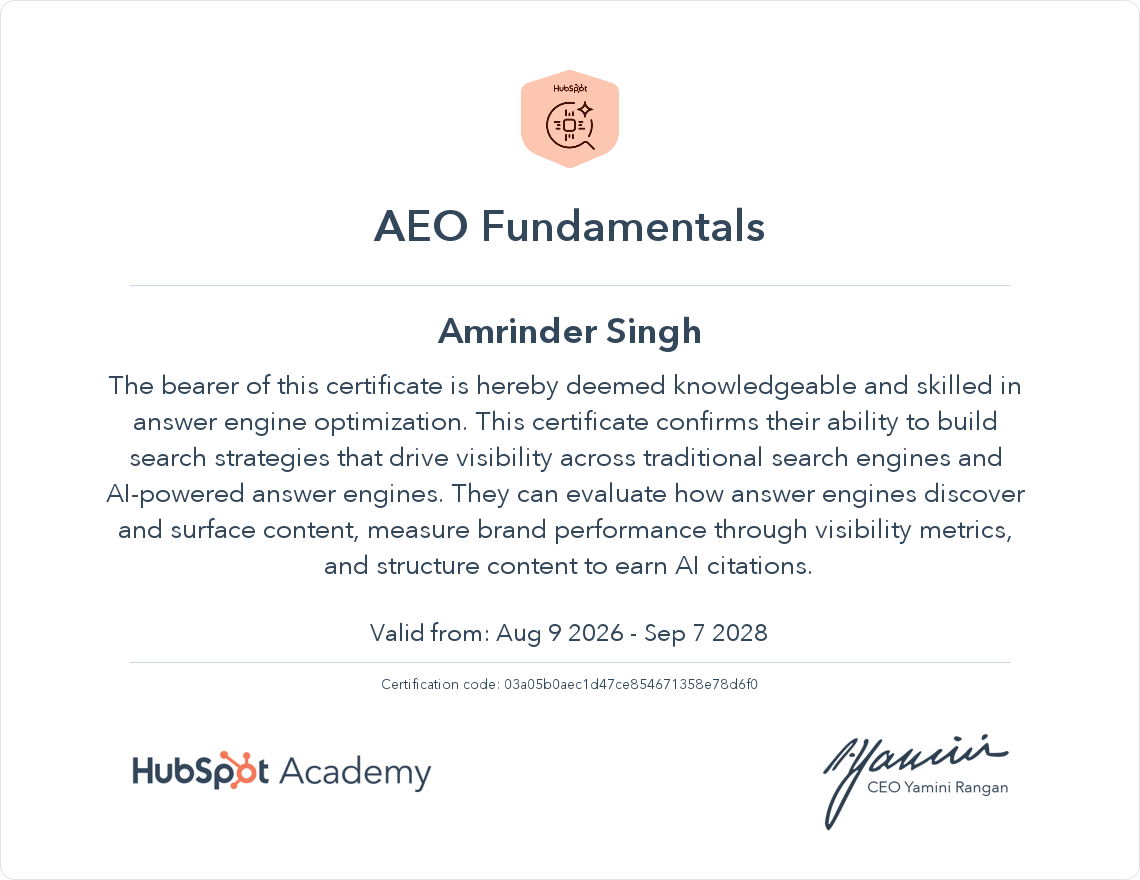
- AEO (Answer Engine Optimisation) — structuring content so AI systems extract and cite it directly
- Prompt engineering for SEO — knowing how to instruct AI tools to produce content that ranks and gets cited
- Traditional on-page and technical SEO — still the foundation everything else rests on
- Data analysis and interpretation — AI produces data; humans extract insight and action
- Brand and authority building — the signals AI uses to decide who to trust
Note from Digi Ustad: In my Delhi practice, clients who panicked and abandoned SEO for AI-only content strategies saw short-term gains followed by ranking volatility. Clients who layered AI efficiency on top of a strong SEO foundation saw sustained growth. The lesson: AI is the accelerant, SEO is the engine.
Is SEO Replaced by AI? The Verdict
Here is a clear, structured answer for those who want it in plain terms:
- SEO is not replaced by AI. It is augmented by AI.
- The core principles — relevance, authority, user experience, technical soundness — are unchanged.
- The execution has changed. AI handles speed and scale. Humans provide strategy, judgment, and trust signals.
- The goal has expanded. You now optimise for traditional search AND AI-generated answers.
- Those who combine SEO expertise with AI literacy will dominate the next decade of search.
Frequently Asked Questions
Will AI replace SEO jobs?
AI is reshaping SEO roles, not eliminating them. According to DemandSage (2026), 69% of SEO specialists will see their job scopes reshaped. SEOs who adopt AI tools and develop skills in GEO, AEO, and data analysis will be in higher demand, not lower.
Is Google SEO dead in 2026?
No. Google SEO is not dead. Organic search traffic declined only 2.5% between early 2024 and late 2025 (Graphite, 2026). Google processes trillions of queries annually and remains the world’s dominant search platform. The SERP has evolved, but SEO strategy remains essential.
What is replacing SEO?
Nothing is replacing SEO. New disciplines like GEO (Generative Engine Optimisation) and AEO (Answer Engine Optimisation) are complementing traditional SEO. A complete 2026 search strategy covers traditional rankings, AI Overview citations, and LLM visibility.
Does AI-generated content rank on Google?
Google’s official position is that it rewards high-quality content regardless of how it is produced. However, AI-generated content without E-E-A-T signals, original insights, or editorial oversight consistently underperforms compared to expert-authored content.
How does AI impact local SEO in India?
Local SEO in India — including Delhi NCR — remains heavily dependent on human expertise. Understanding local search behaviour, building local citations, managing Google Business Profiles, and targeting vernacular queries requires market-specific knowledge that AI tools cannot replicate on their own.
Is SEMrush useful in the AI era?
Yes. SEMrush has integrated AI capabilities across keyword research, content optimisation, and competitive analysis. It remains one of the most powerful tools in a professional SEO’s stack, especially for identifying AI Overview trigger queries and optimising for them.
What is GEO and how is it different from SEO?
GEO (Generative Engine Optimisation) focuses on getting your brand cited within AI-generated answers from systems like ChatGPT, Google Gemini, and Google AI Overviews. SEO focuses on ranking in traditional blue-link results. In 2026, top digital strategies require both.
Summary: AI + SEO = The Winning Formula
After 10+ years optimising websites across competitive industries from Delhi to national campaigns, here is what I know: every major algorithm shift has been followed by predictions that SEO is dead. Panda, Penguin, Hummingbird, RankBrain, BERT — and now AI Overviews. Each time, SEO adapted and grew.
AI is the most significant shift yet. But it is still a shift within search, not a replacement of it.
- Use AI tools to work faster and smarter
- Invest in E-E-A-T signals that AI cannot manufacture
- Optimise for both traditional rankings and AI Overview citations
- Build topical authority — become the source AI wants to cite
- Hire SEO professionals who understand both worlds
SEO is not replaced by AI. It is being upgraded by it. The question is not whether to keep doing SEO — it is whether you are doing the right kind of SEO for 2026.