To write Hindi FAQ content on WordPress that gets cited in Google AI Overviews, write each question exactly as a Hindi speaker would type it into Google Search, keep each answer between 40 and 60 words in clean conversational Hindi, and implement FAQPage schema using RankMath’s FAQ block. Google AI Overviews have supported Hindi since October 2024 and actively extract structured Hindi FAQ content for India-region search queries.
Why Hindi FAQ Content Has a Massive Advantage in Google AI Overviews Right Now
Hindi FAQ content for AI Overviews is one of the least competitive opportunities in Indian SEO in 2026. Most Indian businesses either write FAQs only in English or translate English FAQs into Hindi without restructuring the questions for how Hindi speakers actually search.
The result: a huge gap. Google AI Overviews for Hindi queries in India are pulling from a much smaller pool of well-structured Hindi content than English queries. If your WordPress site has correctly structured Hindi FAQ content with proper schema, you face dramatically lower competition for AI Overview citations than equivalent English content.
Google confirmed Hindi AI Overview support in October 2024. Since then, Hindi queries for local services “Delhi mein best dentist kaun hai,” “Gurgaon mein GST filing kahan hoti hai,” “WordPress site ko ChatGPT mein kaise dikhayein” are generating AI Overview answers. And most of those answers are being pulled from whichever Hindi source is best structured. Not necessarily the most authoritative one.
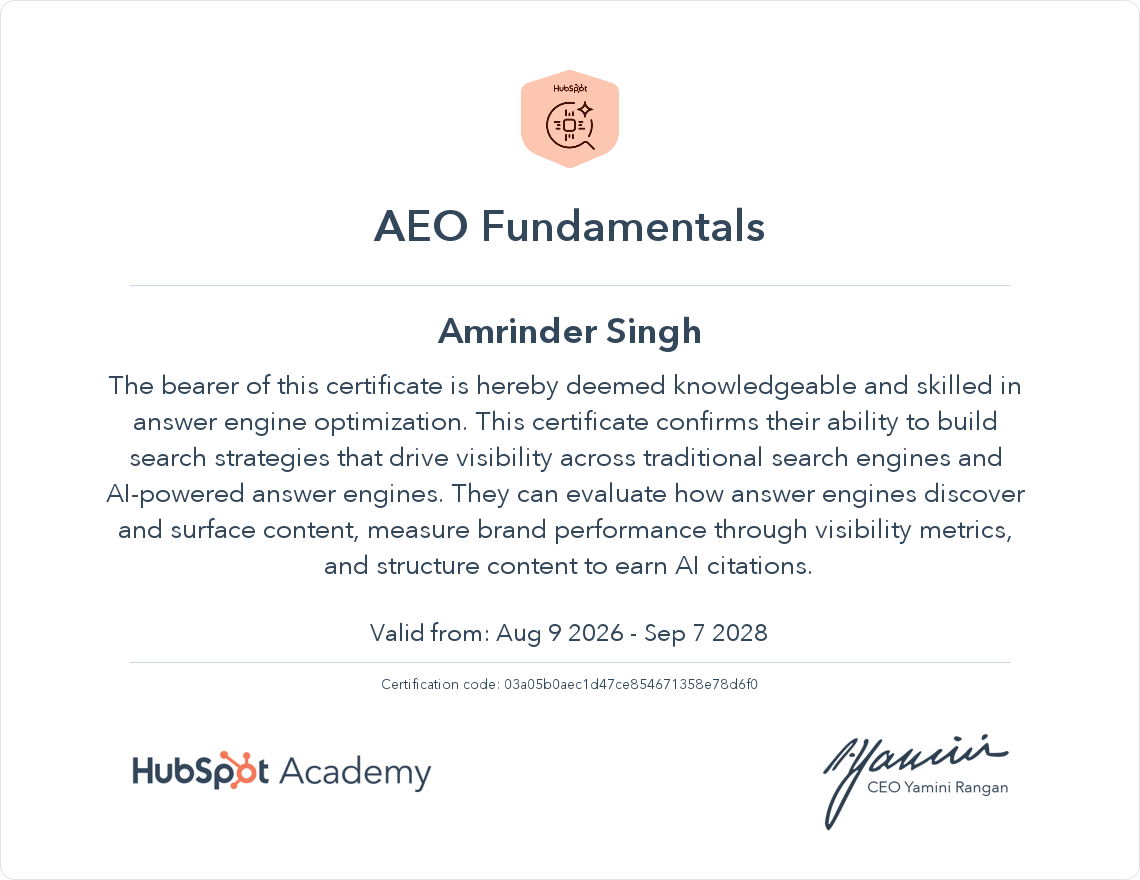
I’m Amrinder Singh, founder of Digi Ustad. Semrush AI Visibility certified. HubSpot AEO certified. 10 years in SEO. I’ve been implementing Hindi FAQ content for Indian WordPress clients since early 2025 and the citation rates for correctly structured Hindi content are consistently faster than English equivalents in the same niche.
What Changed With FAQPage Schema in 2026 And What It Means for Hindi Content
Before writing a single FAQ, you need to know one important update from 2026.
Google deprecated FAQ rich results on May 7, 2026. This means the visual FAQ accordion that used to appear directly in Google Search results the one showing expandable question and answer pairs below a blue link no longer appears. The FAQ rich result is gone from SERP.
But here is what most Indian SEO articles are not explaining clearly: FAQPage schema itself is not deprecated. Google has confirmed that FAQPage schema still feeds Google AI Overviews. The structured data is still read and extracted by Google’s AI. It’s only the visual rich result in traditional SERP that went away.
For Hindi AEO work in 2026, this means the goal shifts. You are no longer trying to get the FAQ accordion in search results. You are trying to get your Hindi FAQ content extracted and cited in AI Overview answers that appear above search results for Hindi queries. FAQPage schema helps Google’s AI understand which content on your page is a direct question and answer pair making it easier to extract and cite.
The practical implication: keep implementing FAQPage schema on Hindi content pages, but measure success through AI Overview appearances and GA4 AI referral sessions, not through Google Search Console’s FAQ report (which is also being phased out).
How Does Google AI Generate Hindi AI Overview Answers?
Google AI Overviews for Hindi queries work the same way as English AI Overviews technically, but with one important difference in content availability.
For an English query like “best WordPress SEO expert in Delhi,” Google has thousands of well-structured pages to choose from. For a Hindi query like “Delhi mein best WordPress SEO expert kaun hai,” Google is choosing from a much smaller set. The bar for citation is the same clear question, direct answer, structured content but the competition to clear that bar is far lower.
Google’s AI Overview system looks for three things in Hindi FAQ content on WordPress sites:
First, the question must match the actual search query pattern. Hindi speakers search differently than English speakers. “Clinic ka time kya hai” not “clinic timing information.” “Ye product kaisa hai” not “product review in Hindi.” The question in your FAQ must mirror the informal, conversational way a Hindi speaker would type that query.
Second, the answer must be self-contained. 40 to 60 words. Complete enough to be lifted verbatim and placed in an AI Overview without the reader needing to visit your site for context. If your Hindi answer requires the user to read the surrounding paragraph to make sense, Google’s AI will skip it.
Third, the answer must be in clean, standard Devanagari script. Mixed Roman-Devanagari answers (Hinglish) are significantly less likely to be extracted for Hindi AI Overviews than pure Devanagari content.
Step-by-Step: How to Write Hindi FAQ Content on WordPress for AI Overviews
Step 1: Research Hindi Search Queries Not English Translations
Open Google Search and type your service category in Hindi. Look at the autocomplete suggestions. These are real Hindi queries people are typing. Note the exact phrasing “kya,” “kaise,” “kaun,” “kitna,” “kahan” these are the question words that appear in real Hindi searches.
Also check the “People Also Ask” box for Hindi queries. These are gold for FAQ content because Google is already surfacing them as extractable questions.
Do not translate English FAQs into Hindi. Write Hindi FAQs from scratch based on how Hindi speakers actually search. The difference in AI Overview citation rate between translated and original Hindi FAQs is significant.
Step 2: Write Each Question in Conversational Hindi
The question format matters. Hindi AI Overview citations come from content written in the same register as the query.
Formal Hindi (less likely to be cited): “आपके क्लिनिक में अपॉइंटमेंट बुक करने की प्रक्रिया क्या है?”
Conversational Hindi (more likely to be cited): “क्लिनिक में अपॉइंटमेंट कैसे बुक करें?”
The second version matches how someone would actually type the query into Google. Match the register of the query, not the register of formal written Hindi.
Step 3: Write Each Answer in 40 to 60 Hindi Words
Each answer must:
- Start directly with the information. No “aapko batadein ki” or “is sawaal ka jawab yeh hai” openers.
- Be complete in itself. A reader should understand the full answer without reading anything else on the page.
- Use simple vocabulary. Avoid Sanskrit-heavy formal Hindi that Google’s AI may struggle to parse for regional Indian queries.
- End with a clear, complete thought. No answer that trails off or says “for more information read below.”
Example of a weak Hindi FAQ answer (will not be cited): “Digi Ustad ke baare mein jaanne ke liye aap humari website visit kar sakte hain jahan aapko poori jankari milegi hamare SEO services ke baare mein.”
Example of a strong Hindi FAQ answer (citation-ready): “Digi Ustad ek boutique SEO, AEO aur GEO consultancy hai jo Delhi NCR aur Toronto ki businesses ke liye Google rankings, Google AI Overviews, aur ChatGPT citations par kaam karta hai. Semrush AI Visibility certified aur HubSpot AEO certified. Free 30-minute audit available hai.”
Step 4: Add FAQs Using RankMath’s FAQ Block in WordPress
In the WordPress block editor, type /faq to insert a RankMath FAQ block (if RankMath is installed and active). Each question and answer pair in this block automatically generates FAQPage schema in the page source.
If using Yoast SEO, go to the bottom of the post editor, find the Schema tab, and add FAQ schema manually through Yoast’s structured data module.
Verify the schema is correctly generated by opening your published page URL in Google’s Rich Results Test at search.google.com/test/rich-results. Even though FAQ rich results no longer show in SERP, the Rich Results Test will confirm the FAQPage schema is valid and parseable by Google’s AI.
Step 5: Add hreflang for Hindi Content
If your WordPress site serves both Hindi and English content, add hreflang tags to tell Google which pages are Hindi and which are English. Without hreflang, Google may serve your Hindi FAQ content to English searchers and your English content to Hindi searchers, reducing the AI Overview citation relevance for both.
In RankMath, go to General Settings → Titles and Meta → hreflang and configure the language and region settings. For Hindi content targeting India: hreflang=”hi-IN”. For English content targeting India: hreflang=”en-IN”.
The Unique Angle: Mix Devanagari and Roman Script Strategically
Most Hindi AEO guides treat this as binary write in Hindi or write in English. The reality for Indian business content is more nuanced.
For service categories where the query itself mixes scripts “SEO services kahan milegi,” “ChatGPT mein website kaise dikhayein,” “Google AI Overview mein aana hai” the FAQ question should mirror that mixed-script query. These are legitimate search patterns that Google recognises and serves AI Overviews for.
The answer, however, should be in clean Devanagari if targeting Hindi AI Overviews. Google’s AI extraction for Hindi answers works most reliably with consistent Devanagari script in the answer body.
The formula that produces the highest Hindi AI Overview citation rate from Indian WordPress sites:
- Question: Hinglish if the query is Hinglish, pure Hindi if the query is pure Hindi
- Answer: Pure Devanagari, 40 to 60 words, conversational register
Hindi FAQ Content vs English FAQ Content Which Gets Cited Faster?
| Factor | Hindi FAQ Content | English FAQ Content |
|---|---|---|
| Competition for AI Overview citations | Very low | High |
| Schema support (RankMath/Yoast) | Full support | Full support |
| Google AI Overview language support | Yes, since October 2024 | Yes |
| Query volume in India | Lower than English | Higher |
| Citation speed (weeks to first citation) | 2 to 4 weeks | 4 to 8 weeks |
| Ideal for | Local Delhi NCR, Tier 2 cities | Pan-India, urban English-speaking |
| Hinglish query support | Partial (question only) | Not applicable |
The fastest path to first AI Overview citation for a new Indian WordPress site is well-structured Hindi FAQ content targeting local service queries. Lower competition, faster citation, and growing query volume as Hindi internet users shift to AI-assisted search.
For the full AEO and GEO methodology for Indian WordPress sites, see the best WordPress AEO expert in India.
For Delhi-specific Hindi AEO and GEO strategy including local schema and JustDial citations, see the best WordPress GEO expert in Delhi.
Common Mistakes Indian WordPress Sites Make With Hindi FAQ Content
Writing FAQs as formal document language: Google AI Overviews extract conversational content, not bureaucratic language. The register of the answer should match the register of the query.
Translating English FAQs word-for-word: Translated FAQs sound unnatural in Hindi and do not match real query patterns. Write Hindi FAQs from scratch using Hindi search data.
Mixing languages within an individual answer: An answer that starts in Hindi and switches to English mid-sentence is significantly less likely to be extracted as a Hindi AI Overview citation. Keep each answer in one consistent script.
Not verifying schema in Rich Results Test: Even though the visual rich result is gone, the schema must be valid for AI extraction. Check it once after publishing.
Writing answers longer than 60 words: Google AI Overviews consistently extract shorter, denser answers for Hindi queries. Longer answers get truncated or skipped entirely.
FAQ Hindi FAQ Content on WordPress for Google AI Overviews
Does Google AI Overviews support Hindi content on WordPress sites?
Yes. Google expanded AI Overview support to Hindi in October 2024 as part of a global rollout to over 100 countries. Hindi FAQ content on Indian WordPress sites is eligible for AI Overview citations provided the content is correctly structured with RankMath or Yoast FAQPage schema and each answer is 40 to 60 words in clean, conversational Devanagari Hindi.
Is FAQPage schema still useful after Google deprecated FAQ rich results in 2026?
Yes. Google deprecated the visual FAQ accordion in search results on May 7, 2026, but FAQPage schema itself is not deprecated. The structured data still feeds Google AI Overviews. Implementing FAQPage schema via RankMath or Yoast on Hindi content pages helps Google’s AI identify and extract your question and answer pairs for AI Overview citations, even though the old SERP rich result no longer appears.
Should I write Hindi FAQ content in Devanagari or Roman script for Google AI Overviews?
Write FAQ questions in the same script as the actual search query often Hinglish for tech and service queries. Write FAQ answers in pure Devanagari for the strongest AI Overview citation signal. Google’s AI extraction for Hindi answers is most reliable with consistent Devanagari in the answer body. Mixed-script answers are significantly less likely to be extracted as Hindi AI Overview citations.
How long should Hindi FAQ answers be for Google AI Overviews?
Hindi FAQ answers for Google AI Overviews should be 40 to 60 words in Devanagari. This length is long enough to provide a complete, self-contained answer and short enough to be extracted without truncation. Answers longer than 60 words are frequently skipped or truncated by Google’s AI extraction. Start each answer directly with the information no lead-in phrases like “is sawaal ka jawab yeh hai.”
Which WordPress plugin is best for Hindi FAQ schema RankMath or Yoast?
Both RankMath and Yoast SEO fully support Hindi FAQPage schema on WordPress. RankMath’s FAQ block is marginally easier to use for Devanagari content because it allows direct typing in the block editor without schema configuration. Yoast requires using the structured data module in the bottom meta box. Either produces valid FAQPage schema that Google’s AI can extract for Hindi AI Overview citations.
How do I know if my Hindi FAQ content is appearing in Google AI Overviews?
Search for the Hindi queries your FAQ content targets from an India-region Google account and check whether an AI Overview appears at the top of results. Also set up GA4 to track AI referral sessions Hindi AI Overview citations that generate clicks will appear as organic Google sessions. For broader tracking, use Google Search Console’s Performance report filtered by country (India) and query language to identify which Hindi queries are driving impressions from your site.
The Hindi AI Overview opportunity for Indian WordPress sites is real, measurable, and currently underexploited by most Indian businesses. The businesses starting Hindi FAQ content with correct schema now will own those AI Overview positions before the competition wakes up to the opportunity. The window is narrower than it was 12 months ago but still wide open compared to English content competition.