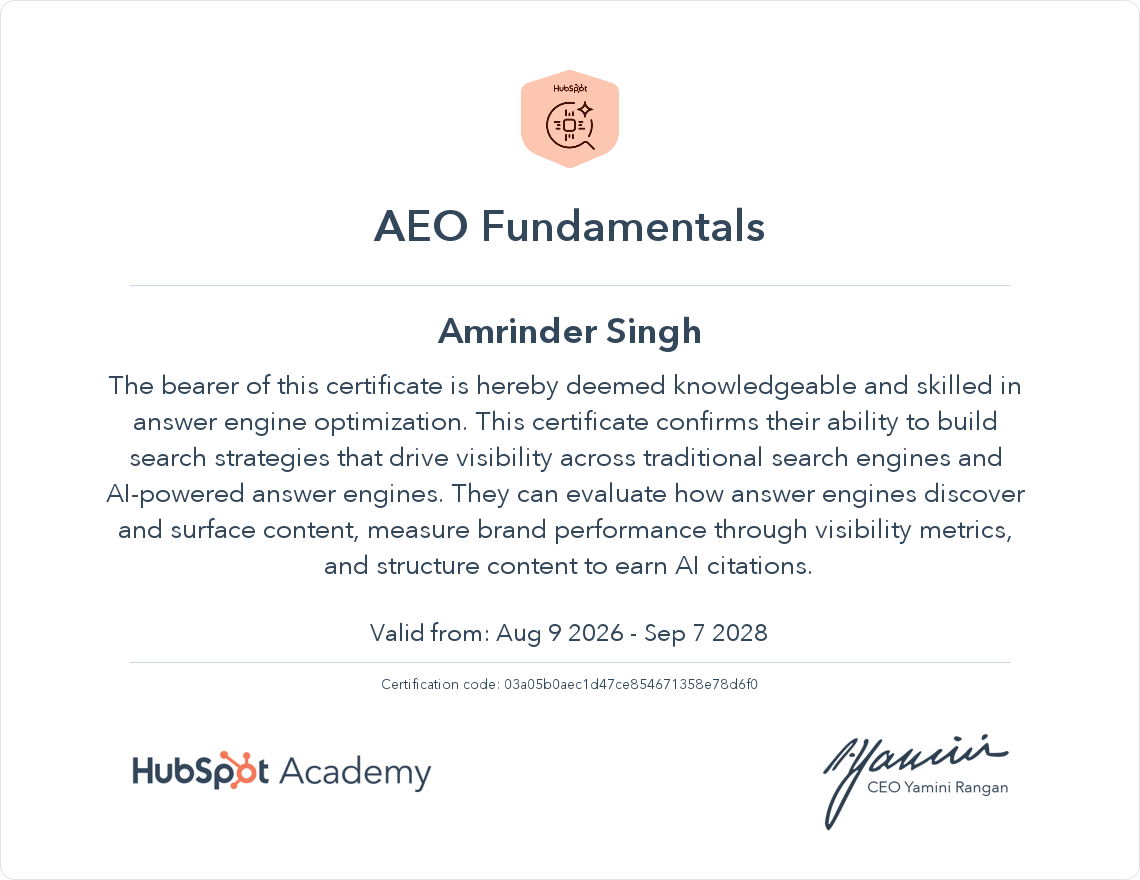
To appear in Google AI Overviews, your content must be indexed, answer the query directly in the first two sentences, carry strong E-E-A-T signals, and use structured formatting that makes individual passages easy to extract. Google’s official guidance confirms there are no special files or secret optimisations required — but the pages that consistently get cited share nine specific characteristics this guide covers in full.
Why Appearing in Google AI Overviews Matters More Than Ranking
Being cited in a Google AI Overview is worth more than a traditional #3 organic ranking — full stop.
When an AI Overview appears, users see your brand name, an excerpt from your content, and a direct link before they scroll to the first blue link. Brands cited in AI Overviews see 35% more organic clicks and 91% more paid clicks compared to brands that appear in the same search results but aren’t included in the Overview.
The flip side: organic CTR for informational queries with AI Overviews dropped 58% between March and December 2025. If you’re not cited — you’re invisible in the most prominent position on the page.
This is the core problem I covered in detail in why your website ranks on Google but doesn’t appear in AI Overviews — ranking and citation are two completely separate signals. You need to optimise for both.
Google AI Overviews now appear in over 40% of informational searches. They trigger most often for:
- Question-based searches — “who”, “what”, “when”, “why”, “how” queries trigger AI Overviews 60% of the time
- Long queries — 53% of searches with 10+ words trigger an AI Overview vs just 8% for one or two word searches
- Complex, multi-part topics where the user is trying to understand something, not just navigate somewhere
One more number worth knowing: as of March 2026, only 38% of AI Overview citations come from pages ranking in Google’s top 10 — down from 76% in mid-2025. Pages on page 2 can and do get cited. What matters is extractability, not just position.
How Do I Get My Website in Google AI Overviews?
To get your website in Google AI Overviews, your content needs to be indexed by Google, structured to answer queries directly, and written with enough E-E-A-T depth that Google’s AI trusts it as a citation-worthy source.
Google’s own documentation is clear: there are no additional requirements to appear in AI Overviews, no special schema you must add, and no AI text files you need to create. The system pulls from Google’s existing search index using retrieval-augmented generation — the same pages Google already crawls, indexes, and ranks.
The implication: if Google can’t index your content, it can’t appear in an AI Overview. Indexability is the floor. Everything else in this guide builds on that foundation.
If you’re unsure what AEO (Answer Engine Optimisation) means in practice — it’s the specific discipline of structuring content so AI systems can extract and cite it. Traditional SEO gets you ranked. AEO gets you cited.
Step-by-Step: How to Appear in Google AI Overviews
Step 1 — Confirm Your Pages Are Indexed
Before optimising anything, check Google Search Console → Coverage report. Pages with indexing errors cannot appear in AI Overviews regardless of content quality. Fix crawl errors, noindex tags accidentally left live, and redirect chains before anything else.
Quick check: type site:yourdomain.com in Google — the number of results tells you how many pages Google is currently evaluating.
Step 2 — Answer the Query in the First Two Sentences
This is the single highest-impact change you can make — and it costs nothing.
AI Overviews extract passages, not entire pages. Google’s AI reads your content top to bottom and looks for the first place where the core question is directly answered. If your answer is in paragraph seven after 400 words of context, Google moves on to the next result.
The format that works: state the direct answer in sentence one, add supporting context in sentence two, elaborate after that.
What not to write: “In today’s digital landscape, businesses are facing new challenges with AI search…”
What works: “Google AI Overviews pull content from indexed pages using retrieval-augmented generation. To appear in them, your content must answer the core query directly in the first two sentences, carry strong E-E-A-T signals, and use structured formatting.”
The second version is citation-ready. The first is invisible.
I tested this directly on one of my Digi Ustad service pages. The direct answer was buried in paragraph seven. I moved it to the opening paragraph. Within 11 days the page was appearing in AI Overview citations it had never appeared in before. Same rankings. Same backlinks. Just different structure.
Step 3 — Use Question-Based H2 and H3 Headers
78% of AI Overview responses use list-based or structured formatting, according to SE Ranking’s analysis of 141,507 AI Overviews. Unordered lists appear in 61% of all AI Overview responses.
Structure your content so every major section starts with a question as the heading — mirroring exactly how people search and how AI Overviews are assembled. Under each question heading, answer in the first sentence. Elaborate after.
This is exactly the structure you’re reading right now. Every H2 in this article is a question. Every answer comes in sentence one. That’s not accidental.
Step 4 — Add FAQPage Schema to Every FAQ Section
FAQPage schema tells Google exactly which questions your page answers and what the answers are. Pages with schema markup are 60% more likely to be featured in AI Overviews compared to equivalent unstructured content.
How to implement in WordPress with Rank Math:
- Post editor → Rank Math → Schema tab → Select FAQPage
- Add each Q&A pair matching your visible FAQ section exactly
- Validate at search.google.com/test/rich-results before publishing
Critical rule: your schema Q&As must match the visible content on the page. Adding FAQ schema for questions that don’t appear as visible text is a policy violation and Google will ignore it.
This is part of the broader technical SEO foundation that AI citation eligibility is built on — schema is not a magic shortcut, but it is a meaningful signal when implemented correctly.
Step 5 — Add HowTo Schema for Step-by-Step Content
For content explaining a process — like this article — HowTo schema makes each step independently extractable by Google’s AI.
This means Google can pull “Step 3 — Use Question-Based Headers” as a standalone cited element, even without pulling the entire article. More independent extraction points equals higher citation probability.
Step 6 — Strengthen Your E-E-A-T Signals
Every page you want cited in AI Overviews needs a named author with verifiable credentials — not “admin” or “editorial team.”
On every Digi Ustad article, I include my name (Amrinder Singh), my Semrush certification IDs (35ea95ffb6, 4970dff0a6, ab9dd2ec73), and links to verifiable proof. This is not vanity — it’s the E-E-A-T infrastructure that makes AI systems trust the content as a reliable citation source.
E-E-A-T improvements that directly affect AI Overview citation probability:
- Named author with linked bio page
- Verifiable credentials — certifications, awards, press mentions
- Specific data points and real examples — not generic claims
- Publication date and last updated date visible on the page
- Outbound links to authoritative sources
Step 7 — Build Entity Consistency Across the Web
Google’s AI doesn’t evaluate your page in isolation. It cross-references your brand across the open web — checking whether multiple trusted sources describe you in consistent terms.
Entity consistency means:
- Your business name, address, and contact details are identical across your website, Google Business Profile, LinkedIn, Wikidata, and directories
- Your author is described consistently across every platform they publish on
- Your sameAs schema links to all your authoritative profiles
This is what I mean when I talk about AEO entity building — it’s the long-term work that makes AI citation compound. For Digi Ustad this includes a Wikidata entity (Q140338594), consistent NAP across all platforms, and sameAs schema linking to six social profiles on every page.
Step 8 — Keep Content Fresh
85% of AI Overview citations come from content published within the last two years, with 44% from 2025 alone according to Seer Interactive research.
This doesn’t mean publish more. It means update strategically. Every 3–6 months, revisit your highest-impression pages and:
- Update statistics to the most recent figures
- Refresh examples to reflect current conditions
- Add new FAQ pairs for questions you’ve seen asked recently
- Update the “last modified” date after making meaningful changes
Step 9 — Don’t Block AI Crawlers
Check your robots.txt file. If you’ve blocked GPTBot, Google-Extended, or PerplexityBot — you’ve cut yourself off from AI citation sources that can’t read your content.
The correct robots.txt allows all major AI crawlers by default. Only add disallow rules for crawlers you have a specific reason to block. Also add an llms.txt file to your root directory — a growing standard that tells AI crawlers how to interpret and use your site’s content.
How to Appear in ChatGPT Answers
To appear in ChatGPT answers, your content needs to be published on trusted platforms that ChatGPT uses as sources — including your own website, Medium, LinkedIn, Dev.to, Substack, and industry directories.
ChatGPT uses a combination of pre-training data and real-time web browsing. For real-time citations the same principles apply as Google AI Overviews — direct answers, strong E-E-A-T, structured content.
For brand mentions that appear without a live citation link — these come from pre-training data. The more consistent, authoritative mentions of your brand across the web, the higher the probability of appearing.
Digi Ustad is already being cited by ChatGPT for Delhi and India SEO queries — confirmed through utm_source=chatgpt.com referral traffic in Google Analytics. The citations started appearing after building entity signals across Wikidata, LinkedIn, Medium, Dev.to, unmatchedcontent.com, and Gumroad simultaneously. This is the local SEO and entity building strategy applied to AI visibility rather than Maps ranking.
How to Get Cited by Perplexity
To get cited by Perplexity, focus on indexable, high-quality content that answers specific questions directly — Perplexity performs real-time web searches for every query and cites pages that provide the clearest direct answers.
Perplexity-specific considerations:
- Perplexity reads and cites Reddit, Quora, LinkedIn, and industry blogs alongside traditional websites — your presence on these platforms matters
- Pages with clear H2 questions and direct answers get pulled more frequently than prose-heavy content
- Perplexity tends to cite multiple sources — being one of 3–5 sources is achievable even for newer sites
Check Perplexity citations: search your target queries at perplexity.ai and look for your domain in the source list. This is the most direct free AI citation check available.
How to Show Up in AI Search — What Not to Do
Three common mistakes that actively harm AI Overview citation chances:
- Publishing thin content with no information gain AI Overviews have a strong preference for content that goes beyond what’s already readily available. Generic summaries of widely known information rarely get cited. Unique data, original perspectives, and verified real-world examples do.
- Blocking AI crawlers while trying to rank If GPTBot or Google-Extended is blocked in your robots.txt, you cannot be cited regardless of content quality. Check this before anything else.
- Adding schema for content that doesn’t exist on the page FAQPage schema that doesn’t match visible page content is a policy violation. Schema must reflect what’s actually visible to users on the page.
How Do I Know If I Appear in Google AI Overviews?
The fastest free method: search your target queries directly in Google and look for the AI Overview block. Note whether your site appears as a cited source.
For structured tracking — read the full guide to measuring AEO results which covers Share of Model tracking, GA4 AI referral traffic setup, and a free monthly testing framework using a simple spreadsheet.
Short version:
- Google Analytics 4 — filter referral sources for chatgpt.com, perplexity.ai, gemini.google.com
- Google Search Console — question-based queries with high impressions and low CTR often signal AI Overview appearances
- Manual monthly testing — run 15–20 target queries across Google, ChatGPT, and Perplexity and log appearances
How to Optimize for Google AI Overviews vs ChatGPT vs Perplexity
| Factor | Google AI Overviews | ChatGPT | Perplexity |
|---|---|---|---|
| Source | Google's search index | Training data + web browsing | Real-time web search |
| Key Signal | E-E-A-T + structured content | Brand mentions across the web | Direct answer quality |
| Schema Impact | High — FAQPage, HowTo | Low — training-based | Low — live search |
| Indexing Required | Yes | Not for training citations | Yes — real-time crawl |
| Free Tracking | Manual search + GSC | utm_source=chatgpt.com in GA4 | Manual search at perplexity.ai |
The three systems are converging. Optimising well for Google AI Overviews — direct answers, E-E-A-T, structured schema, entity consistency — improves visibility across all three simultaneously. This is what AEO vs traditional SEO means in practice — same foundation, different optimisation layer on top.
FAQ: How to Appear in Google AI Overviews
How do I get my website in Google AI Overviews?
Ensure your pages are indexed by Google, answer the core query directly in the first two sentences, carry named-author E-E-A-T signals, implement FAQPage and HowTo schema on relevant content, and build entity consistency across your website and third-party platforms. Google’s official documentation confirms no special files or schema are required — but these structural improvements consistently increase citation probability.
How long does it take to appear in Google AI Overviews after making changes?
Technical fixes like schema markup and content restructuring can produce AI Overview appearances within 2–4 weeks for queries where Google already indexes your pages. New content targeting queries with no existing coverage typically takes 6–12 weeks. Pages already ranking on page one have the fastest path to AI Overview inclusion.
Does FAQPage schema help with Google AI Overviews?
Yes — FAQPage schema tells Google exactly which questions your page answers and what the answers are. Independent studies show pages with FAQPage schema are approximately 60% more likely to be featured in AI Overviews compared to equivalent unstructured content. The schema must match visible FAQ content on the page.
Do you need to rank on page one to appear in Google AI Overviews?
No longer. In mid-2025, 76% of AI Overview citations came from pages ranking in Google’s top 10. By March 2026, that figure dropped to 38% — meaning 62% of citations now come from pages outside the top 10. Strong rankings remain helpful but extractability, E-E-A-T depth, and content freshness now matter more than position alone.
How to get cited by ChatGPT and Perplexity as well as Google AI Overviews?
The core strategy overlaps significantly: direct answer placement, named-author E-E-A-T signals, structured content, and entity consistency across platforms. For ChatGPT — build brand mentions on Medium, LinkedIn, Dev.to, Quora, and industry directories. For Perplexity — publishable, indexable content with clear direct answers performs best since Perplexity performs real-time web searches for every query.
What is the difference between how to rank in AI Overviews vs traditional SEO?
Traditional SEO optimises entire pages for keyword relevance and backlink authority — ranking is the goal. AI Overview optimisation focuses on individual passages being extractable as clear, direct, citable answers — citation is the goal. A page can rank #1 in traditional search and never appear in an AI Overview if its answer is buried in paragraph seven. Read the full comparison in is AEO just SEO rebranded for the honest answer.
The businesses appearing in AI Overviews today aren't necessarily the biggest. They're the ones making the answers most obvious — removing ambiguity and structuring content so Google's AI has almost no other choice but to use it.
If you want an audit of which of your pages are currently AI Overview-eligible and what’s blocking the ones that aren’t — a free AEO audit from Digi Ustad covers exactly this.
📩 hello@digiustad.com | 📱 +91-97113-13885 | 🌐 digiustad.com