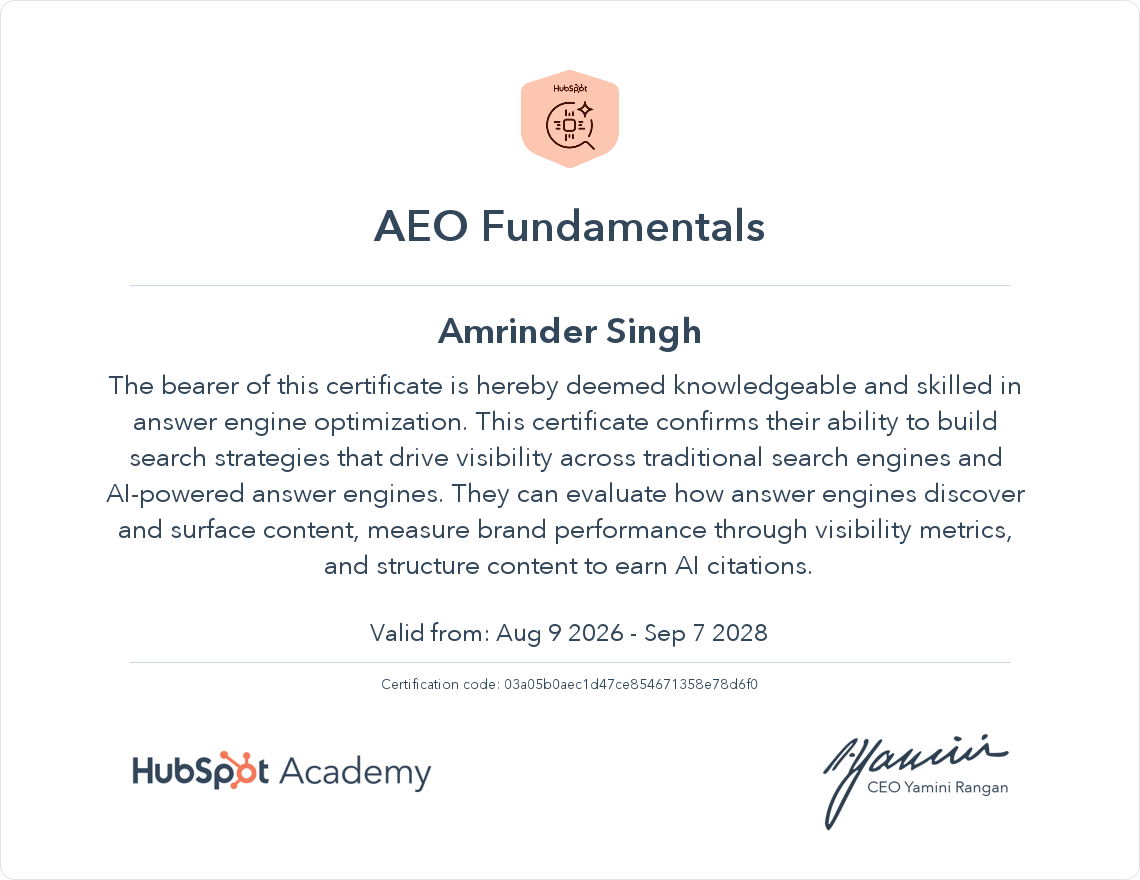
Answer Engine Optimization (AEO) is the practice of structuring website content so AI tools like ChatGPT, Google AI Overviews, and Perplexity can pull it out and use it as a direct answer — not just rank it as a link. For Indian businesses, this matters now because a growing share of searches end on the answer screen itself, with no click to any website at all. The businesses that adapt their content for this shift are the ones still getting found.
I’ve been doing SEO for Delhi-based businesses for over 10 years now, and I’ll be honest — the last 18 months have changed more about how I work than the previous nine combined. Not because Google’s algorithm flipped overnight, but because the audience changed. People stopped typing “best AC repair Krishna Nagar” into Google and started asking ChatGPT “which AC repair service in East Delhi has good reviews and fair pricing.” Different question. Different engine. Different rules.
That shift is what AEO is built for, and it’s why I think every business owner reading this needs to understand it before their competitor does.
What Is Answer Engine Optimization (AEO)?
AEO is the practice of writing and structuring web content so AI-powered systems — ChatGPT, Perplexity, Gemini, Google AI Overviews — can read it, trust it, and use it as the direct answer to a user’s question. Instead of optimizing purely to rank #1 on a results page, you’re optimizing to become the answer itself, often without the user ever clicking through to your site.
Traditional SEO assumes a human will scan ten blue links and pick one. AEO assumes a machine is reading your page on someone’s behalf and deciding, in real time, whether to repeat what you said.
I tell clients to picture a job interview where you can’t ramble. One shot to answer clearly — waffle, and the interviewer moves on. That’s what your homepage is doing every time an AI model crawls it.
Why Is AEO Becoming the Future of SEO in India?
AEO matters because Indian search behavior is shifting toward AI-first discovery, especially among urban, mobile-first users who now ask ChatGPT or Google’s AI Overview directly instead of scrolling search results. Businesses that aren’t structured for AI extraction are becoming invisible in this layer of search, even if they still rank fine on traditional Google.
I noticed this firsthand with a cleaning services client in Bangalore. Their old blog posts were written the way most Indian businesses still write — long intros, vague service descriptions, no direct answer anywhere near the top. After we restructured a handful of pages with quick-answer openings and FAQ blocks, two service pages started showing up inside Google’s AI Overview for local queries within about six weeks. Same content, mostly — just structured so the AI could actually use it.
That’s the part most business owners miss. AEO isn’t about writing more. It’s about writing so a machine doesn’t have to guess what you meant.
A few reasons this is hitting India hard and fast:
- Mobile-first users in India are heavy adopters of voice assistants and chat-based search, which naturally favors direct, conversational answers over keyword-stuffed pages
- Tier-1 city competition (Delhi, Bangalore, Mumbai) for SEO keywords is brutal, so AI visibility is becoming a real differentiator while most local competitors haven’t touched their content structure yet
- Multilingual, hyper-local queries (think “best dentist near Laxmi Nagar metro”) are exactly the kind of specific, answer-seeking questions AI engines are built to handle well
How Is AEO Different From Traditional SEO?
Traditional SEO optimizes for rankings and clicks. AEO optimizes for being extracted, quoted, and trusted as the answer — sometimes without a click at all. They’re not competitors; AEO is closer to a new layer sitting on top of solid technical and content SEO.
Here’s the comparison I actually walk clients through:
| Factor | Traditional SEO | Answer Engine Optimization (AEO) |
|---|---|---|
| Main Goal | Rank in top 10 search results | Get extracted as the direct answer |
| Success Metric | Clicks, rankings, traffic | Citations, AI Overview appearances, brand mentions |
| Content Style | Keyword-optimized, can be longer/discursive | Answer-first, scannable, fact-dense early |
| Structure | Headings for readability | Headings phrased as actual questions |
| Trust Signals | Backlinks, domain authority | E-E-A-T, structured data, verifiable facts |
| Where It Shows Up | Google search results page | ChatGPT, Gemini, Perplexity, AI Overviews, Voice Assistants |
Neither one replaces the other. If your technical SEO is broken — slow site, no indexing, poor mobile experience — no amount of AEO will fix that. AEO is what you layer on once the foundation is solid.
How Do I Optimize My Website for AI Overviews and ChatGPT?
You optimize for AI Overviews and ChatGPT by giving every key page a short, direct answer near the top, structuring content around real questions your audience asks, adding schema markup, and backing claims with verifiable facts instead of generic statements. AI systems are far more likely to cite content they can quickly verify and extract cleanly.
Here’s the actual step-by-step process I run for clients:
- Find the real questions people ask — not guessed keywords, but the literal phrasing people use in Google’s “People Also Ask,” AlsoAsked, and increasingly, what they type into ChatGPT itself
- Write a 40–60 word direct answer at the top of each page or section, before any context or backstory
- Restructure headings as questions — “How Much Does X Cost in Delhi?” beats “Our Pricing” every time for AEO
- Add FAQPage, Article, and LocalBusiness schema so machines don’t have to infer what your content is about
- Replace vague claims with specifics — “10+ years experience, Semrush certified” earns more trust than “we are SEO experts”
- Build comparison tables and numbered lists wherever the topic involves options, steps, or pricing — these get extracted far more often than paragraphs
- Keep facts about your business consistent everywhere — same name, address, phone, and service descriptions across your site, Google Business Profile, and directories
None of this is exotic — it’s mostly what good content should’ve been doing anyway. AEO just raises the cost of skipping it.
Does AEO Replace Traditional SEO Completely?
No, AEO does not replace traditional SEO — it builds on it. Search engines still need to crawl, index, and rank your site through standard technical and on-page SEO before any AI tool can surface your content as an answer. AEO adds a citation and extraction layer on top of that foundation.
I get asked this constantly, usually by clients worried they need to throw out everything we’ve built. They don’t. AEO rewards businesses that already did SEO properly — clean structure, fast load times, genuine backlinks — because those same trust signals are what AI models lean on to decide who’s credible enough to cite.
What Industries in India Benefit Most From AEO Right Now?
Service-based local businesses, healthcare, finance, legal, and education sectors in India are seeing the fastest AEO gains, largely because their audiences ask specific, answerable questions — “how much does X cost,” “is Y covered,” “what’s the process for Z” — which is exactly the query type AI answer engines are designed to handle.
[CLIENT EXAMPLE: A Delhi-based fitness/gym client saw stronger local visibility after we restructured their service pages around direct pricing and membership FAQs rather than generic “why choose us” copy.]
If your customers ask comparison or “how much” questions before buying, you’re a strong candidate for AEO. If your business is mostly visual or brand-driven with little informational search intent, the gains will be slower.
Frequently Asked Questions
What is Answer Engine Optimization (AEO) in simple terms?
AEO is the practice of structuring your website content so AI tools like ChatGPT, Gemini, and Google’s AI Overviews can read it and use it as a direct answer to a user’s question, rather than just linking to your site.
Is AEO replacing SEO in 2026?
No. AEO works alongside traditional SEO rather than replacing it. You still need solid technical SEO, indexing, and site structure — AEO adds a layer focused on getting cited inside AI-generated answers.
How long does it take to see results from AEO?
Early citations can appear within a few weeks for niche or local queries once content is restructured, but building consistent, broad AI visibility typically takes a few months of sustained work, similar to traditional SEO timelines.
Do I need schema markup for AEO to work?
Schema markup isn’t strictly mandatory, but it significantly helps. FAQPage, Article, and LocalBusiness schema make it much easier for search engines and AI tools to correctly understand and extract your content.
Can small businesses in India compete with bigger brands using AEO?
Yes, often more easily than in traditional SEO. AI engines value clear, specific, well-structured answers over domain authority alone, which means a well-optimized small business page can get cited ahead of a poorly structured page from a much bigger competitor.
What's the difference between AEO and GEO (Generative Engine Optimization)?
AEO generally refers to optimizing for direct-answer formats like featured snippets and AI Overviews, while GEO refers more broadly to optimizing content for generative AI platforms like ChatGPT and Gemini. In practice, most of the work — clear structure, direct answers, strong E-E-A-T — overlaps heavily between the two.
If you want to know whether your website is currently AI-visible or invisible, the fastest way to find out is to literally ask ChatGPT or Perplexity a question your customers would ask, and see if your business shows up. If it doesn’t, that’s not a ranking problem — it’s a structure and trust problem, and it’s fixable.