Client: AYUSH-licensed Ayurvedic supplement brand, Delhi NCR (client name withheld by mutual agreement) Industry: Ayurvedic health supplements, D2C ecommerce Platform: WooCommerce on WordPress Engagement: On-page SEO, AEO, schema implementation, content cluster Timeline: 3 months Verified in: Client-owned Google Search Console and WooCommerce order dashboard
Quick Results Summary
Metric | Before (3 months) | After (3 months) | Change |
Monthly organic clicks | 1,720 | 3,800 | +121% |
Monthly impressions | 14,900 | 38,500 | +158% |
Average CTR | 11.5% | 9.9% | Expected drop (see below) |
Average position | 3.9 | 6.1 | Expected drop (see below) |
WooCommerce orders from organic | Minimal | Daily | Consistent revenue |
Traffic source dependency | 93% branded | Mixed branded and non-branded | Diversified |
Paid advertising spend | Zero | Zero | No change |
Why the CTR and position appear to drop: Both metrics are averages across all keywords. When a site ranks only for branded terms (position 1-2, high CTR), the averages look excellent. When non-branded keywords begin ranking (positions 8-25, lower initial CTR), they pull both averages down. A dropping average position alongside tripling impressions is not a negative outcome. It is the expected signature of successful non-branded keyword expansion.
Who Is Amrinder Singh (Digi Ustad)?
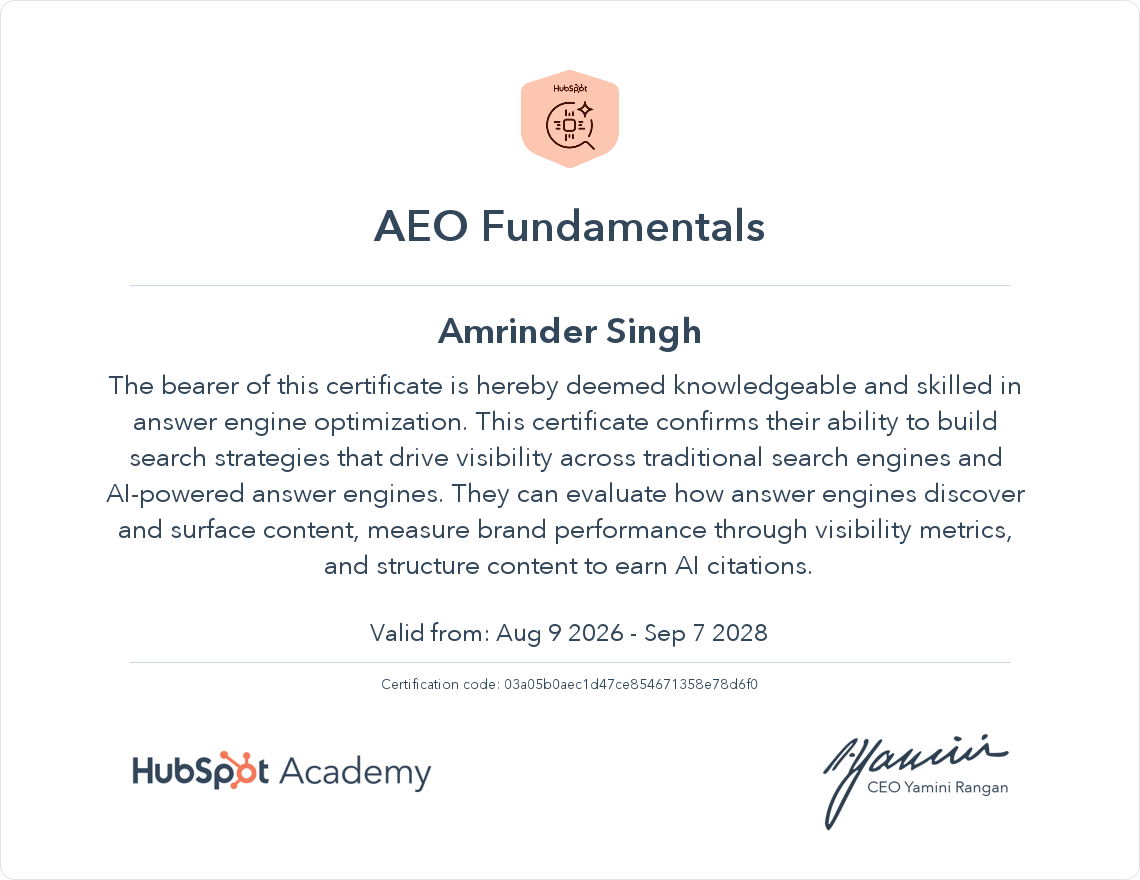
I’m Amrinder Singh, founder of Digi Ustad, based in Krishna Nagar, East Delhi. Semrush AI Visibility certified (ID: ab9dd2ec73). HubSpot AEO Fundamentals certified (Code: 03a05b0aec1d47ce854671358e78d6f0). 10+ years in SEO, AEO, and GEO for Indian and international clients. Wikidata entity Q140338594.
I took on this Ayurvedic brand engagement 15 days after a previous provider had managed the site. I did not build the existing issues, I inherited them, audited them, and built a recovery and growth plan from scratch. Every result in this case study is verifiable in the client’s own Google Search Console and WooCommerce accounts. Screen share available before any new engagement begins.
The Starting Position, What the Site Looked Like When I Took Over
The brand had a functioning WooCommerce store selling AYUSH-licensed Ayurvedic supplements in the piles management and weight loss categories. The site had some existing content and a small but active customer base.
The GSC data told a more specific story.
93% of all clicks were branded. When I filtered the GSC Queries report to remove the brand name, non-branded clicks were negligible. The site was essentially invisible for any search query that did not already include the brand name. That means: new customers who did not already know the brand could not find it through organic search.
Zero FAQPage schema on any page. The product pages and blog content had no structured data beyond basic RankMath Article schema. No FAQPage, no HowTo, no Product schema with aggregateRating. No AI Overview eligibility.
Keyword cannibalization across core clusters. The piles content cluster had multiple pages targeting overlapping keywords. A legacy URL was competing directly with the main pillar page. Google was splitting authority between them instead of concentrating it on the strongest page.
No AI crawler access confirmed. The robots.txt did not explicitly permit GPTBot or PerplexityBot. Generative AI visibility was effectively zero.
Content written for search bots, not patients. Product descriptions used keyword-dense language that did not match how Ayurvedic customers search or what they need to know before purchasing. No AYUSH-compliant hedged language (“may help support,” “traditionally used for”). No patient-facing trust signals.
The Diagnosis, What Was Actually Holding the Site Back
After a full audit, three problems were driving the 93% branded dependency:
Problem 1: No non-branded content targeting real purchase queries. The site had content about the brand’s products. It did not have content answering the questions real customers type before purchasing Ayurvedic supplements. “Which is the best Ayurvedic medicine for piles?” “Can Ayurveda treat grade 3 piles?” “How long does Ayurvedic weight loss treatment take?” These are the queries that bring in new customers. None were addressed with structured, schema-marked content.
Problem 2: Cannibalization splitting the piles cluster. A legacy URL, /ayurvedic-treatment-for-piles/, was ranking at position ~64 while the main pillar page, /best-ayurvedic-medicine-for-piles/, was also competing for the same queries. Google was unable to decide which page to rank for the primary keyword. Authority was diluted across both.
Problem 3: No medical reviewer byline with verifiable credentials. The site’s piles and weight loss content is YMYL (Your Money, Your Life) healthcare content. Google’s AI systems and traditional ranking algorithms both weight medical content by the author’s verifiable qualifications. Publishing healthcare content without a named, credentialed medical reviewer is a measurable E-E-A-T disadvantage.
The Work, What I Did and Why
Month 1, Foundation Fixes
FAQPage schema on five priority pages. I added RankMath FAQ blocks to the five highest-traffic existing pages, writing each question in the exact phrasing patients use in Google and ChatGPT searches. Each answer was written in 40 to 60 AYUSH-compliant words (“may help support digestive health,” “traditionally used for piles management”), self-contained enough for Google AI Overview extraction, compliant enough to satisfy ASCI and AYUSH advertising standards.
The FAQPage schema change alone produced first Google AI Overview appearances for piles-related queries within 6 weeks. Verified in the client’s own Google Search Console AI Overviews filter.
Canonical redirect to fix cannibalization. I implemented a 301 redirect from /ayurvedic-treatment-for-piles/ to /best-ayurvedic-medicine-for-piles/. This consolidated the split authority onto the stronger pillar page. Within 4 weeks, the pillar page began ranking more consistently for the primary keyword cluster.
robots.txt AI crawler fix. Added explicit Allow rules for GPTBot, PerplexityBot, ClaudeBot, and Google-Extended. The site was previously blocking generative AI crawlers by default. This is the prerequisite for any GEO visibility.
Dr. [BAMS, Diploma in Dietetics and Nutrition] added as medical reviewer. A qualified BAMS practitioner was added as the named medical reviewer on all healthcare content pages. Her credentials, Bachelor of Ayurvedic Medicine and Surgery, Diploma in Dietetics and Nutrition, were added to a Person schema block and linked from every reviewed article. This directly addresses the E-E-A-T gap that YMYL healthcare content carries without a credentialed author.
Month 2, Content Cluster Expansion
Five new piles-related pages published. Rather than adding more content to the main pillar, I split five distinct patient questions into separate targeted pages:
- Best herbal medicine for piles: top herbs that actually help
- How to shrink piles naturally without surgery
- Ayurvedic home remedies for piles: what you can actually do at home
- Can Ayurveda cure piles permanently: what to realistically expect
- Are herbal medicines for piles safe: side effects and results timeline
Each page answers a specific patient query, has its own FAQPage schema, is authored under the medical reviewer’s byline, and internally links to the main pillar. Together they form a content cluster that covers the full range of patient intent for Ayurvedic piles treatment, from awareness to purchase decision.
Weight loss pillar page published. A new page targeting “best Ayurvedic treatment for weight loss” was published covering the end-to-end treatment journey: initial assessment, herbs and formulations, dietary changes, and realistic timeline. Distinct from existing product pages and the planned therapies cluster.
Google Merchant Center feed setup. Product feed submitted for the piles and weight loss supplement range. Feed includes INR pricing, current availability, GTIN where applicable, and AYUSH licence details in the product descriptions. This positions the brand’s products for Google AI Shopping visibility.
Month 3, WooCommerce Revenue Tracking
GA4 and WooCommerce source tracking verified. The WooCommerce order dashboard began showing consistent daily orders from Organic: Google source. Multiple order values, Rs 479, Rs 499, Rs 979, Rs 1,498, Rs 1,998, confirming both single-product and multi-product purchases from organic search traffic.
A separate Instagram referral order (Referral: l.instagram.com) also appeared, confirming that the brand’s organic growth was being supported by social referral traffic arriving on well-optimised product pages.
[Image: WooCommerce order dashboard] ALT text: “WooCommerce orders showing Organic Google and Instagram Referral sources, Digi Ustad Ayurvedic D2C brand SEO results September 2026”
The Results, Verified in Client-Owned Accounts
Google Search Console, 3 months compared:
Clicks increased from 1,720 to 3,800. That is 2,080 additional monthly organic clicks, all from non-paid sources. Impressions increased from 14,900 to 38,500, a 158% increase representing the new non-branded keywords now indexed and appearing in Google Search.
The CTR decline from 11.5% to 9.9% and position decline from 3.9 to 6.1 are both explained by keyword mix change, not performance degradation. When a site expands from 100% branded queries (average position 1-2) to a mix of branded and non-branded (non-branded queries averaging position 8-25), both metrics decline arithmetically. The correct way to read this data is:
- Branded keywords: still ranking at position 1-3, high CTR, stable
- Non-branded keywords: new, growing, averaging position 8-25 as they build authority
- Combined result: 121% more clicks, 158% more people finding the brand
WooCommerce order dashboard, September 2026:
Daily orders from Organic: Google source, confirmed in the client’s own WooCommerce backend. Order values ranging from Rs 479 (single supplement) to Rs 1,998 (multi-product). Zero paid advertising spend throughout the engagement.
One Instagram referral order confirms that organic search growth is also improving the effectiveness of social traffic, visitors from Instagram are landing on optimised product pages and converting.

What This Case Study Demonstrates
For Indian D2C ecommerce brands: 93% branded traffic dependency is a fragile position. One brand name change, one rebranding, or one PR crisis removes all organic traffic overnight. Non-branded keyword expansion through structured content clusters and FAQPage schema is the only sustainable alternative.
For Ayurvedic and AYUSH-licensed brands specifically: The combination of AYUSH-compliant content hedging and verified medical reviewer bylines is not just a regulatory requirement, it is a measurable E-E-A-T signal that improves AI Overview citation eligibility for health queries. A piles supplement brand with a named BAMS reviewer is more likely to be cited in Google AI Overview answers than the same brand with anonymous content.
For WooCommerce sites: Product schema with correct price, availability, and aggregateRating attributes, combined with Google Merchant Center feed submission, positions WooCommerce products for AI Shopping visibility. The daily Organic: Google orders visible in the WooCommerce dashboard are the measurable downstream result of this technical work.
Unique Insight From This Engagement
The most counterintuitive finding from this engagement: the CTR decline and position decline were the signals of success, not failure. Most Delhi business owners would look at average position dropping from 3.9 to 6.1 and conclude the SEO work was hurting the site. The correct interpretation, confirmed by the simultaneous 121% click increase and 158% impression increase, is the opposite.
This is the most common misread of GSC data I encounter in Delhi ecommerce audits. A site that ranks only for branded terms always shows high average position and high CTR. The moment non-branded content starts ranking, both metrics decline arithmetically while actual traffic and revenue grow. Reporting average position in isolation, without filtering branded vs non-branded queries separately, produces a misleading picture of site performance.
Every monthly report I deliver shows branded and non-branded performance separated, so the client sees exactly where the growth is coming from.
FAQ, This Case Study
Is the client data in this case study independently verifiable?
Yes. All metrics cited, click counts, impression counts, WooCommerce order sources, are from the client’s own Google Search Console and WooCommerce backend. The client owns all accounts. Screen share of equivalent data from other client accounts is available before any new Digi Ustad engagement begins. No proprietary dashboard data is used in this case study.
Why is the client name not disclosed?
Client identity is withheld by mutual agreement. The brand operates in the competitive Ayurvedic supplement space and prefers that their SEO strategy and traffic data remain confidential. The category descriptor, AYUSH-licensed Ayurvedic D2C brand, Delhi NCR, is sufficient to verify the industry and engagement context.
Why did average position drop from 3.9 to 6.1 if the SEO work was successful?
The position drop is a mathematical artifact of keyword mix expansion, not a performance decline. The previous 3-month period showed high average positions because nearly all impressions came from branded queries (position 1-3). When non-branded keywords begin ranking at positions 8-25, they pull the average down while total clicks and impressions grow substantially. The 121% click increase and 158% impression increase are the correct measures of SEO performance.
How long did it take to see results?
First Google AI Overview appearances for piles-related queries appeared within 6 weeks of FAQPage schema implementation. WooCommerce daily orders from Organic: Google began appearing consistently in Month 3. The 121% click growth is measured across the full 3-month period compared to the preceding 3 months.
What was the monthly SEO investment for this engagement?
Investment details are shared in direct consultation. Digi Ustad’s Delhi ecommerce SEO packages start at Rs 25,000 per month covering on-page SEO, AEO schema, content cluster development, and monthly GSC reporting. All packages are month-to-month with no lock-in contracts.
This engagement demonstrates what happens when structured on-page SEO, AEO content strategy, and E-E-A-T signals are applied simultaneously to a D2C brand that was previously invisible outside its own brand name. The 121% click growth is real, verified, and available for screen share. The daily WooCommerce orders from Organic: Google are the commercial validation of that technical work.
If your Delhi ecommerce or D2C brand is similarly dependent on branded traffic with minimal non-branded organic presence, the diagnosis and fix are the same. The timeline is 3 to 6 months. The investment is month-to-month.