Indian businesses can get cited in Google AI Overviews by implementing FAQPage schema on key service pages, writing self-contained Quick Answer blocks in the first 60 words of each page, structuring content to directly answer specific questions, and building verified author credentials. Google AI Overviews now appear on 20 to 35% of all Google searches in India, and only 17 to 38% of cited pages also rank in the organic top 10 — meaning this is not a reward for existing rankings. It is a separate competition that any Indian business can win with the right content structure.
Why Indian Businesses Have a Specific AI Overview Advantage in 2026
Search intent: informational with commercial undertone. An Indian business owner or marketer who wants the practical steps to get their website appearing in Google AI Overviews, not theoretical background on what AI Overviews are.
The data point most Indian businesses miss is the low competition advantage. India-specific business content is significantly underrepresented in well-structured, authoritative form. The volume of correctly structured AEO content about Indian legal compliance, Indian tax filing, Indian healthcare regulations, Indian real estate rules, and Indian consumer behaviour is dramatically lower than equivalent content for Western markets. Google’s AI is pulling from a smaller, lower-quality pool of India-specific content for many Indian professional queries.
This means the bar to get cited is lower in India than in the US or UK for the same content category. An Indian CA firm with well-structured FAQPage schema answering “how to file ITR online” or “what is the GST exemption limit for small businesses” is competing against a fraction of the well-optimised content that an equivalent Western accounting firm would face.
ChatGPT is the second most used platform among Indian professionals in 2026. Perplexity grew 640% year on year in India. Google AI Overviews reach more than 1 billion monthly users globally, with Hindi language support since October 2024. The Indian professional audience using AI search tools as their primary research method is growing faster than Indian content creators are adapting to serve them.
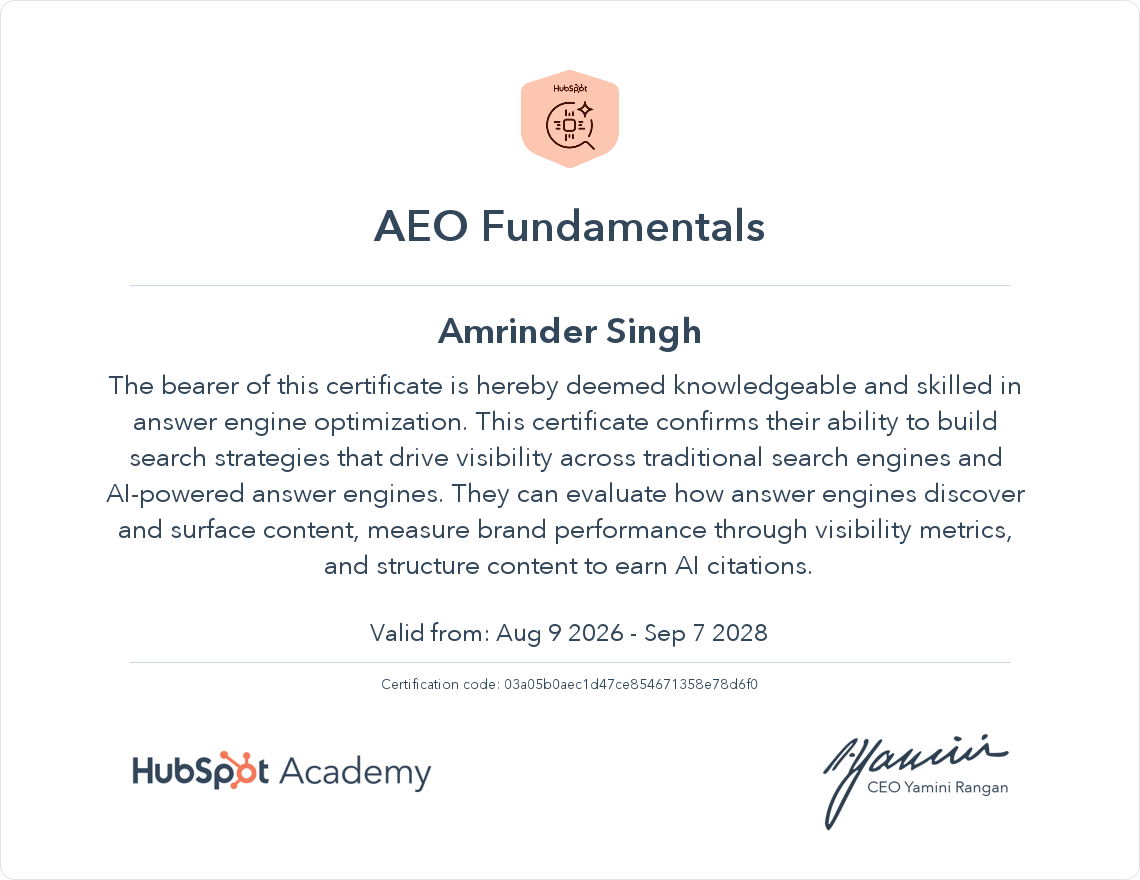
I’m Amrinder Singh, founder of Digi Ustad, based in Krishna Nagar, East Delhi. Semrush AI Visibility certified (ID: ab9dd2ec73). HubSpot AEO Fundamentals certified. 10 years in search and AEO for Indian and international clients. The Indian businesses getting into Google AI Overviews right now are not the biggest brands. They are the ones that implemented the right content structure before their category competitors started.
What Does Google AI Overviews Actually Look For When Citing Indian Content?
Google AI Overviews looks for four specific things in Indian content before citing it: a direct answer in the first 60 words, structured question-answer pairs with FAQPage schema, verifiable author credentials, and content freshness with a recent dateModified in schema.
The most important insight is what AI Overviews does NOT look for: your domain authority, your backlink count, or your existing position in traditional Google search. Research published by BrightEdge and Ahrefs in 2026 confirms that only 17 to 38% of pages cited in AI Overviews also rank in the organic top 10 for the same query. Most citations come from pages that are well-structured and directly answering but sitting in positions 11 to 40 in traditional search.
This is significant for Indian businesses. You do not need to be ranking number 1 on Google to get cited in Google AI Overviews. You need to be answering the question better and more directly than the pages that are ranking number 1.
For Indian businesses writing in English, this means: answer the question in the first sentence, not after three paragraphs of context. For Indian businesses with Hindi content, this means: write conversational Devanagari answers that match the exact phrasing of Hindi voice searches and typed queries on Android.
What Is the Fastest AEO Action for Indian Businesses to Get Into AI Overviews?
The fastest single AEO action for Indian businesses is adding FAQPage schema via RankMath or Yoast to existing service pages. Not new pages. Existing pages that already have some Google visibility.
Here is why this is faster than creating new content. Google’s AI already knows about your existing pages from prior crawls. When you add structured FAQPage schema to a page Google already understands, the AI has new, clearly signalled question-answer pairs to extract from a source it already trusts. The turnaround for first AI Overview citations from this action is typically 4 to 8 weeks for Indian WordPress sites.
Creating a new page targeting AI Overview citations requires Google to discover, crawl, index, and develop confidence in that page before it can be cited. That adds 6 to 12 weeks to the baseline timeline.
The practical sequence for Indian businesses:
- Identify your 5 most-visited existing pages in Google Search Console
- Add 4 to 6 FAQ questions to each page in RankMath’s FAQ block
- Write each answer in 40 to 60 words, starting directly with the information
- Validate schema at search.google.com/test/rich-results
- Submit each URL via Google Search Console URL Inspection, Request Indexing
Done correctly, this five-step process on five existing pages is the fastest available path to first AI Overview citations for an Indian business website.
The Complete AEO Playbook — Seven Actions for Indian Businesses
Action 1: Quick Answer Block in the First 60 Words
Every key service page on your Indian business website needs a Quick Answer block in the first 60 words. This is a standalone 2 to 3 sentence summary that answers the core question your page is about, written so completely that a reader understands the full answer without reading further.
A Delhi physiotherapy clinic’s homepage opening: “ABC Physiotherapy provides physiotherapy treatment in Rohini, Delhi, for post-surgical rehabilitation, sports injuries, and chronic pain conditions. Appointments available Monday to Saturday. Consultation fee Rs 500.”
That 35-word opening is extractable. Google’s AI can lift it and cite it for queries like “physiotherapy clinic in Rohini” or “physio appointment Delhi.” The three-paragraph backstory that most Indian clinic websites open with is not extractable for AI Overviews.
Action 2: FAQPage Schema on Every Service Page
Use RankMath’s FAQ block to add 4 to 6 questions and answers to every service page. Write questions as real Indian customer queries. “What is the fee for physiotherapy in Rohini?” not “Frequently Asked Questions.” Write answers in 40 to 60 words, starting directly with the answer.
Action 3: Question-Format H2 Headers
Rewrite your H2 headers as questions. “Our Services” becomes “What physiotherapy services do we offer in Rohini?” “About Us” becomes “Who is the best physiotherapist in Rohini?” The question format matches how AI Overviews extract content for voice searches and typed queries.
Action 4: Author Entity with Verified Credentials
Add a Person schema block to your author profile linking your name to verifiable credentials. For Indian businesses this means: BAMS for Ayurveda content, CA or CMA for finance content, LLB for legal content, MBBS or MD for medical content. Google’s AI weights content from verified expert authors significantly more heavily than anonymous content, particularly for YMYL (Your Money, Your Life) Indian topics including healthcare, legal, and financial services.
Action 5: Hindi FAQ Content for Regional AI Overview Coverage
Google AI Overviews support Hindi since October 2024. Hindi FAQ content with FAQPage schema targets the large and growing Hindi-language AI Overview opportunity that almost no Indian business has addressed. Write FAQ questions in the same conversational register as Hindi voice searches. Write FAQ answers in clean Devanagari, 40 to 60 words, self-contained.
Hindi AI Overview competition is significantly lower than English for equivalent Indian service categories. A Delhi clinic that publishes well-structured Hindi FAQ content targeting “Rohini mein best physiotherapist kaun hai” or “Delhi mein physiotherapy ki fees kya hai” is competing against far fewer well-optimised sources than the same clinic competing for English AI Overviews.
Action 6: Content Freshness Signals
Update the dateModified field in your Article schema whenever you update a page, even if the update is small. Google’s AI weights fresh content more heavily than stale content for queries where recency matters — pricing, regulations, availability, and current best practices. For Indian business content covering GST rates, SEBI regulations, AYUSH guidelines, or RBI policy, freshness is a direct AI Overview citation factor.
Action 7: India-Specific Entity Building
Google’s AI cites sources it recognises as credible entities. For Indian businesses, entity building means consistent presence across: Wikipedia (or Wikidata — even a stub entry strengthens entity recognition), JustDial, Sulekha, IndiaMart, and relevant industry directories. A Delhi CA firm listed consistently on Wikidata, ICAI’s member directory, and JustDial has a measurably stronger entity signal than an equivalent firm with only a website.
The Unique Insight — India-Specific Queries Have Lower AI Citation Competition Than Indian Businesses Realise
Every Indian AEO guide focuses on general best practices. None of them quantify the specific citation competition advantage that India-specific content has over equivalent Western content.
Consider a comparison. A query like “what is the income tax exemption limit for senior citizens” has significantly more well-structured, correctly schema-marked English content than a query like “senior citizen income tax exemption India 2026 in Hindi” or “Delhi mein property registration fees kya hai.” The India-specific version of the same financial query has 10 to 50 times fewer well-structured sources competing for the AI Overview citation slot.
For Indian businesses, this means: the fastest path to AI Overview citations is not competing on generic English queries where Western content dominates. It is building well-structured content on India-specific variants of those queries — with Indian regulatory context, Indian pricing, Indian compliance requirements, and where appropriate, Hindi language answers.
A Delhi tax consultancy that publishes well-structured content on “GST registration for freelancers in India” or “how to file ITR for a sole proprietorship in Delhi” with correct FAQPage schema is competing in a pool of sources dramatically smaller than any equivalent US or UK tax query. The citation opportunity is proportionally larger.
[INSERT SCREENSHOT: Google AI Overviews showing citation of an Indian business for a Hindi-language local service query] ALT text: “Google AI Overviews citing an Indian business website for a Delhi-specific service query — AEO result for Digi Ustad client”
For the full AI Overview citations for Indian websites methodology including Hindi AEO, FAQPage schema implementation, and GA4 AI referral tracking, see the AEO expert India service page.
AEO Implementation Comparison — Which Actions Produce AI Overview Citations Fastest for Indian Businesses
Action | Time to Implement | Time to First Citation | Competition Level India | Priority |
FAQPage schema on existing pages | 2 to 4 hours | 4 to 8 weeks | Low | Highest |
Quick Answer blocks on service pages | 1 to 2 hours | 4 to 8 weeks | Low | Highest |
Question-format H2 headers | 1 hour | 6 to 10 weeks | Low | High |
Hindi FAQ content | 3 to 5 hours per page | 3 to 6 weeks | Very Low | High |
Author entity with credentials | 2 hours | 8 to 12 weeks | Low | High |
Content freshness updates | 30 minutes | Immediate signal | N/A | Medium |
India-specific entity building | 4 to 6 hours | 8 to 16 weeks | Low | Medium |
FAQ — How Indian Businesses Get Cited in Google AI Overviews
What percentage of Google searches in India show AI Overviews?
Google AI Overviews appear on approximately 20 to 35% of Google searches in India as of 2026, according to research published by Nevatrix. The percentage is higher for question-format queries — 60% of question-style searches trigger an AI Overview globally — and lower for transactional and product searches. Indian professional queries on legal, financial, and healthcare topics show consistently high AI Overview trigger rates.
Do I need to be ranking on page 1 of Google to get cited in AI Overviews?
No. Only 17 to 38% of pages cited in Google AI Overviews also rank in the organic top 10 for the same query, according to BrightEdge and Ahrefs 2026 research. Most citations come from pages in positions 11 to 40. For Indian businesses, this means well-structured content with FAQPage schema can earn AI Overview citations even from lower-ranking pages, as long as the content directly and completely answers the target query.
Which schema plugin should Indian WordPress sites use for AI Overview optimisation?
RankMath is the recommended schema plugin for Indian WordPress sites targeting Google AI Overview citations. RankMath’s FAQ block generates valid FAQPage JSON-LD automatically on every page where it is added. Yoast SEO also supports FAQPage schema through its structured data module. Both produce valid schema that Google’s AI can extract for Indian English and Hindi content. Validate all schema at search.google.com/test/rich-results after publishing.
Does Hindi content get cited in Google AI Overviews?
Yes. Google AI Overviews have supported Hindi since October 2024 as part of a global expansion to over 100 countries. Hindi FAQ content with correct FAQPage schema is eligible for AI Overview citations for Hindi-language queries in India. Hindi AI Overview competition is significantly lower than English for equivalent Indian service categories, making Hindi AEO one of the fastest citation opportunities available to Indian businesses in 2026.
How long does it take for Indian businesses to appear in Google AI Overviews after implementing AEO?
Featured snippet and AI Overview citations typically appear within the first 4 to 8 weeks of dedicated AEO implementation for Indian WordPress sites with existing Google visibility, according to Nico Digital’s 2026 benchmark data from their Indian client retainer book. Hindi FAQ content with correct schema tends to produce faster citations due to lower competition in AI training data for Hindi queries. Submit updated URLs via Google Search Console URL Inspection to accelerate recrawl after schema changes.
What makes Indian business content more likely to be cited in AI Overviews than generic content?
Three factors make Indian business content specifically more likely to be cited in Google AI Overviews: India-specific regulatory context (GST rates, SEBI rules, AYUSH guidelines), India-specific pricing in INR, and Hindi language answers for regional queries. Google’s AI prefers contextually specific, geographically relevant content over generic international content for Indian queries. An Indian CA firm publishing content about Indian ITR filing with correct FAQPage schema is competing against a much smaller pool of well-structured sources than equivalent Western content.
The Google AI Overview citation opportunity for Indian businesses is wider than most Indian SEO guides acknowledge. The competition for India-specific query citations is lower. The Hindi AEO opportunity is almost completely unclaimed. And the technical implementation — FAQPage schema, Quick Answer blocks, question-format H2s — is within reach of any Indian business with a WordPress site and RankMath installed.
The businesses that build this foundation in the next 90 days will own AI Overview citation positions before the Indian market catches up to what AEO actually requires.