Client: Toronto-based airport parking and valet service (Etobicoke, Ontario) Industry: Airport parking — valet and self-park near Toronto Pearson International Airport (YYZ) Location: Etobicoke, Ontario, Canada SEO Consultant: Amrinder Singh, Digi Ustad Period: 6-month comparison (last 6 months vs previous 6 months)
Results at a Glance
| Metric | Previous 6 Months | Last 6 Months | Change |
|---|---|---|---|
| Total Organic Clicks | 3,220 | 6,010 | +86.6% |
| Total Impressions | 173,000 | 522,000 | +201.7% |
| Average CTR | 1.9% | 1.2% | Expected — Explained Below |
| Average Position | 23 | 16.1 | +6.9 Position Improvement |
| Data Source | Google Search Console | Google Search Console | ✓ GSC Verified |
Organic clicks nearly doubled. Impressions tripled. Average position improved by almost 7 positions. In one of Canada’s most competitive local service categories — airport parking near Toronto Pearson — these numbers represent a significant, measurable shift in organic visibility.
About the Client
The client is a valet and self-park airport parking service located a few minutes from Toronto Pearson International Airport (YYZ) in Etobicoke, Ontario. They offer:
- Valet parking with curbside pickup and drop-off at Terminal 1 and Terminal 3
- Long-term parking with 24/7 CCTV monitoring and controlled access
- Free shuttle service to T1 and T3
- EV charging on request
- Dedicated limo and oversized vehicle bays
- Corporate accounts and flexible booking
The Toronto airport parking market is intensely competitive. The client competes against Pearson’s own on-airport garages, national parking brands, and dozens of independent off-airport operators — all targeting the same high-value, high-intent traveller searching for parking near YYZ.
The Challenge
When this client started working with Digi Ustad, the organic search situation looked like this:
- 173,000 impressions over 6 months — visible in search but not converting that visibility into traffic
- Average position of 23 — appearing mostly on page 2 and 3 where very few clicks happen
- No dedicated service-specific landing pages targeting individual high-intent queries
- Thin content on key pages — homepage carried most SEO weight with insufficient depth
- No FAQ schema or structured data — missing rich result opportunities in a category where FAQ dropdowns regularly appear in SERPs
- CTR of 1.9% — low because meta titles and descriptions weren’t matching searcher intent closely enough
Airport parking customers search with very specific intent — they are not researching, they are comparing and deciding. Ranking on page 2 for those queries means capturing almost none of that ready-to-book intent.
The Strategy
Layer 1 — Service-Specific Landing Pages
The highest-impact structural change was building dedicated landing pages for each distinct service and use case.
Airport parking customers search with highly specific queries:
- “Toronto Pearson valet parking”
- “long term parking Toronto airport”
- “park and fly Toronto Pearson”
- “Terminal 1 parking Toronto”
- “discount parking Toronto airport”
- “Toronto Pearson parking rates”
Each of these is a separate query pool with separate competition and separate conversion intent. A single homepage cannot rank competitively for all of them simultaneously.
I built dedicated pages for each service category — valet parking, long-term parking, fly-and-park, terminal-specific parking, discount parking, and rates. Each page was keyword-optimised for its specific query pool with unique content addressing the particular questions and concerns of that searcher type.
This page architecture is what drove the 201% impression growth — the site went from being evaluated by Google for a handful of broad queries to being considered for dozens of specific, high-intent search terms.
Layer 2 — Content Depth and Search Intent Matching
The Toronto airport parking market is dominated by well-funded competitors with established domain authority. To compete, every page needed to be demonstrably more useful to the searcher — not just keyword-matched, but genuinely more helpful.
Content on each page was structured to answer the specific questions airport parking customers ask at different decision stages:
Comparison stage: How does off-airport parking compare to on-airport garages at Pearson? What’s the price difference? How long does the shuttle take?
Decision stage: Is security reliable? What happens if my flight is delayed? Can I change my booking last minute? Do you accommodate oversized vehicles?
Logistics stage: Where exactly is the lot? What’s the best route from HWY 401/427? How far in advance should I arrive?
Each question was answered directly on the relevant page — integrated into the content where most relevant to the searcher’s journey, not buried in a generic footer FAQ.
Layer 3 — FAQ Schema and Structured Data
Airport parking is a category where FAQ rich results appear consistently in Google SERPs. I implemented FAQPage schema across the homepage and all key service pages covering the most commonly searched questions in the Toronto airport parking category:
- How much does Toronto airport parking cost per day at YYZ?
- Is off-airport parking cheaper than on-site at Pearson?
- Which lots offer 24/7 security and CCTV?
- Do Toronto airport parking options include free shuttles to T1 and T3?
- Where can I find EV charging near Pearson?
These FAQ schema implementations serve two purposes: improving CTR when rich results appear in SERPs, and making pages eligible for Google AI Overview citations — increasingly important as AI search adoption grows in Canada.
Layer 4 — Technical SEO Foundations
Key technical work included:
- Meta title and description optimisation — each page rewritten to match the specific intent of the target query and improve CTR from existing impressions
- Internal linking structure — connecting the service hub to individual service pages efficiently, passing authority where conversions happen
- Mobile page speed — airport parking searches have very high mobile usage; travellers searching from phones during trip planning
- Schema markup — LocalBusiness schema with geo coordinates, service area, and operating hours; Service schema on individual pages
Understanding the CTR Change
The average CTR moved from 1.9% to 1.2% — which at first glance looks like a decline. This requires context.
When a site’s impressions grow from 173K to 522K — a 3x increase — the new impressions are predominantly from newly ranking queries where the site appears at lower positions (15–30 range). Clicks at those positions are naturally lower percentage than clicks at positions 1–5.
The key metric is absolute clicks, not CTR percentage:
| Period | Impressions | CTR | Absolute Clicks |
|---|---|---|---|
| Previous 6 Months | 173,000 | 1.9% | 3,220 |
| Last 6 Months | 522,000 | 1.2% | 6,010 |
Despite the CTR percentage dropping, absolute clicks grew by 86.6%. The site is getting significantly more traffic — the CTR percentage dilution is a natural consequence of ranking for many more queries across a wider range of positions.
As the new pages continue improving in position — moving from average 16.1 toward the top 10 — CTR will naturally rise on the expanded impression base, compounding the click growth further.
Revenue Context
At average booking values of CAD $150–$300 per reservation for airport parking, and a conservative 2% conversion rate from organic clicks:
6,010 organic clicks × 2% = approximately 120 bookings from organic search in 6 months.
At CAD $200 average booking value = approximately CAD $24,000 in organic-driven revenue in 6 months from a channel that previously generated a fraction of that.
As positions improve and the expanded impression base converts at higher rates, this organic revenue figure will compound without proportional increases in cost.
What Made This Work
Service-specific depth over generic breadth. Most airport parking websites try to rank for everything from one homepage. Building a dedicated, authoritative page for each service type multiplied the site’s rankable surface area dramatically. Each page is an independent opportunity to rank and convert.
Booking-intent content. Airport parking customers are ready to book — not researching. Content structured to answer the specific questions at the final stage of the decision process (security, shuttle time, pricing transparency, vehicle fit) converts significantly better than generic service descriptions.
Consistent, methodical work. The results above came from structured execution — not a one-time sprint. Month 1–2 was foundation. Month 3–4 was early ranking movement. Month 5–6 was compounding results. SEO in competitive Canadian local markets follows this pattern reliably.
About Amrinder Singh — Digi Ustad
I’m Amrinder Singh, founder of Digi Ustad, a boutique SEO consultancy based in Krishna Nagar, East Delhi, India. I work with service businesses across India, Canada, Australia, and New Zealand — helping them build organic search visibility that generates measurable enquiries and revenue.
Credentials:
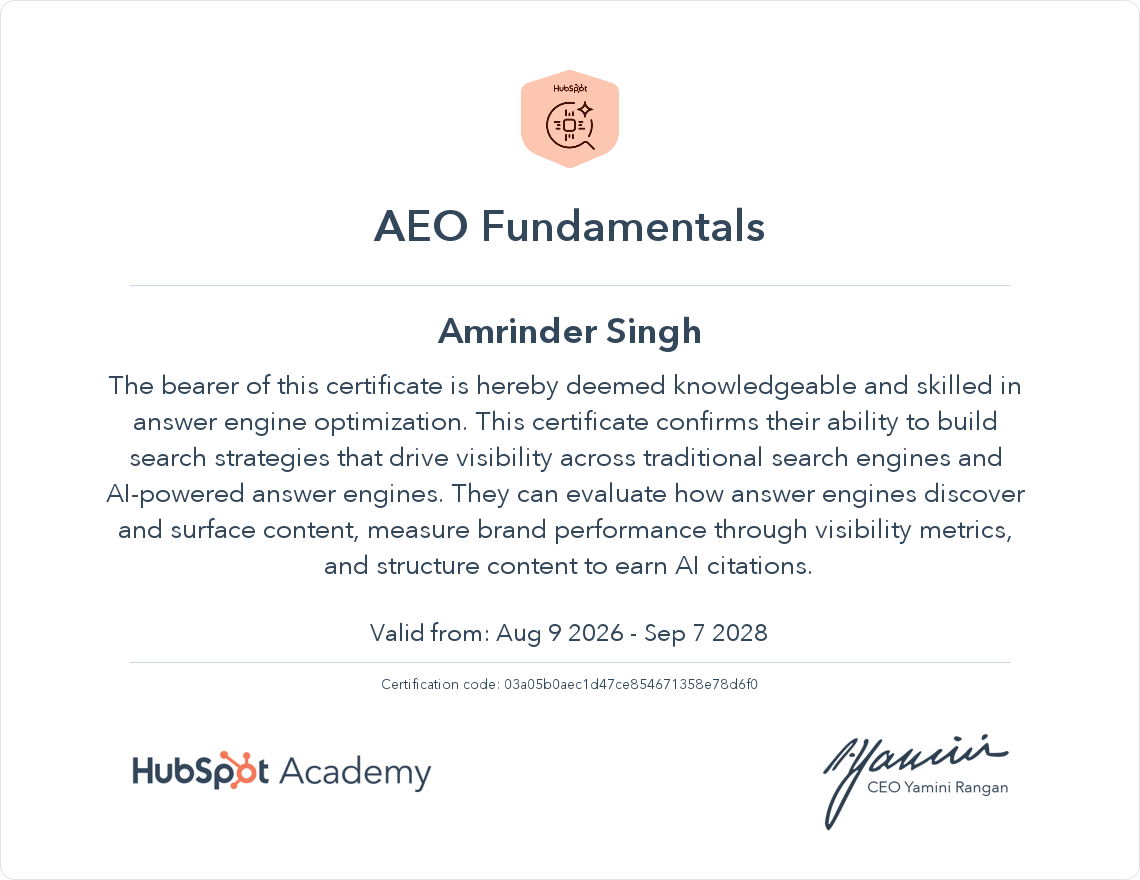
- Semrush certified — SEO Fundamentals (ID: 35ea95ffb6), Keyword Research Essentials (ID: 4970dff0a6), AI Visibility Essentials (ID: ab9dd2ec73)
- 10+ years of SEO experience
- 200+ businesses ranked across Delhi NCR and internationally
Other verified results:
- BrownBoysMotorClub (Oshawa, Ontario): 510% increase in organic clicks, 3,157% increase in impressions over 6 months — GSC verified
- NorthBlackLimousine (Vaughan, Ontario): 60 real form enquiries in 30 days, 25,800 impressions — GSC and Fluent Forms verified
Want Similar Results for Your Business?
If you run a service business in Canada, Australia, New Zealand, or Delhi NCR — and you’re relying on paid ads rather than organic search — this case study shows what a structured, service-specific SEO strategy can deliver.
Email: hello@digiustad.com
WhatsApp: +91-97113-13885
digiustad.com
All results in this case study are verified through Google Search Console. The client has requested anonymity — business category and location details are accurate; the business name has been withheld at the client’s request.